


कायदा जाणून घ्या
Difference Between Rental Agreement And Leave & License Agreement In India
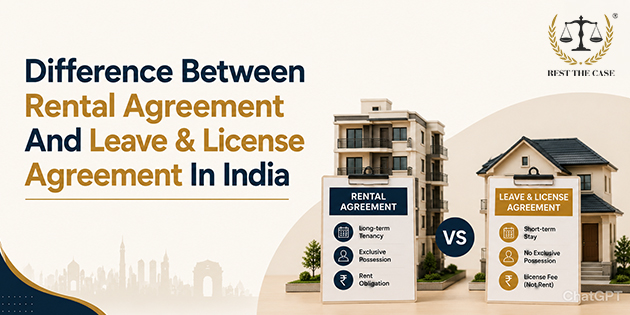

1.1. Key features of a Rental Agreement:
2. What Is A Leave And License Agreement?2.1. Key features of a Leave and License Agreement:
3. Key Differences Between Rental Agreement And Leave & License Agreement 4. Advantages & Disadvantages4.2. 2. Leave and License Agreement
5. Which Agreement Should You Choose?5.1. Consider a rental agreement if:
5.2. Consider a leave & license agreement if:
6. Registration And Legal Requirements6.2. For Leave & License Agreements:
7. Common Mistakes To Avoid 8. ConclusionA rental agreement and a leave & license agreement are both used when someone allows another person to stay in a property, but they create very different legal rights and responsibilities. A rental agreement gives the tenant a legal interest in the property and is generally governed by rent control laws in many states. A leave & license agreement only gives temporary permission to occupy the premises without transferring any ownership or tenancy rights. Depending on the type of agreement used, the parties may face the following:
- Different eviction procedures and legal protections
- Variation in stamp duty and registration requirements
- Different rights over possession and use of the property
- Disputes regarding tenancy rights, notice periods, or security deposits
- Legal complications if the wrong agreement format is used for the arrangement
In most Indian cities, especially for residential flats, leave & license agreements are more commonly used because they give the owner greater control and make it easier to recover possession of the property.
What Is A Rental Agreement?
A rental agreement is a legal contract between a property owner (landlord) and a tenant that allows the tenant to use or occupy a property for a fixed period in exchange for rent. The Rental Agreements in India are primarily governed by the Transfer of Property Act, 1882. The agreement usually contains terms such as the rent amount, duration of stay, security deposit, notice period, and the rights and responsibilities of both parties.
Key features of a Rental Agreement:
- Creates a formal tenancy relationship with a transfer of interest in property to the tenant for the duration of the agreement
- Typically used for long-term in nature (12 months or more)
- Provides strong legal protection to tenants like the right to live in the property without interference
- Forced removal requires court proceedings and legal cause and also the right to question unfair or sudden rent increases.
What Is A Leave And License Agreement?
A leave and license agreement is a legal contract where a property owner (called the licensor) gives another person (called the licensee) permission to use a property for a specific period without transferring any ownership or tenancy rights. This arrangement is governed by Section 52 of the Indian Easements Act, 1882, which defines a license as a personal right to do something on another person's immovable property, a right that would otherwise be considered illegal.
Key features of a Leave and License Agreement:
- No transfer of ownership or tenancy rights; only temporary permission to use the property is granted
- Fixed duration of stay, clearly mentioned in the agreement (commonly 11 months, extendable)
- Easier eviction process for the owner once the agreement expires or is terminated
- Mandatory written agreement with clearly defined terms and conditions
- Clearly defined usage restrictions (no subletting or unauthorized commercial use unless allowed)
Key Differences Between Rental Agreement And Leave & License Agreement
The table below captures the distinctions between the two:
Parameter | Rental Agreement | Leave & License Agreement |
|---|---|---|
Nature of Rights | Creates tenancy rights in favor of the tenant | Only grants a personal, temporary permission to occupy |
Legal Ownership & Interest | Legal interest in the property is transferred to the tenant | No legal interest is created |
Governing Law | Transfer of Property Act, 1882 | Indian Easements Act, 1882 |
Typical Duration | 12 months or longer | Usually 11 months, renewable by a fresh agreement |
Eviction Process | Complex; requires court order, valid legal grounds, lengthy proceedings | Comparatively simpler; the owner can reclaim on expiry or valid notice |
Transferability | Can sometimes be inherited or sublet (subject to terms) | Strictly non-transferable; cannot be sublet or inherited |
Control Over Property | Tenant holds exclusive possession; landlord cannot enter without notice | The owner retains a higher degree of control over the premises |
Rent Control Protection | Tenant enjoys protection under the State Rent Control Acts | Generally falls outside rent control regulations |
Best For | Long-term tenants seeking stability and legal security | Short-term stays; landlords seeking flexibility and control |
Advantages & Disadvantages
1. Rental Agreement
A rental agreement offers stronger legal protection and long-term stability for tenants, but it can reduce flexibility for landlords.
Advantages | Disadvantages |
|---|---|
Greater security for tenants and protection from arbitrary removal | Removing a tenant can become a lengthy legal process for landlords |
Protection against unfair rent increases under many State Rent Control laws | Landlords may face restrictions on rent increases and property use |
More stability for families and long-term occupants | Long-term tenancy disputes can become legally complicated |
2. Leave and License Agreement
A leave and license agreement is more flexible and commonly used for modern urban living and short-term arrangements.
Advantages | Disadvantages |
|---|---|
Greater control and flexibility for property owners | Occupants receive limited legal protection |
Easier recovery of possession after the agreement ends | No long-term security, as renewal depends on the owner |
More freedom to negotiate terms since most arrangements fall outside rent control laws | Rights are generally personal and cannot usually be transferred or inherited |
Suitable for students, working professionals, and temporary stays |
Which Agreement Should You Choose?
Consider a rental agreement if:
- You plan to stay in the property for the long term, especially with family
- You want stronger legal protection and security of tenure
- You prefer stability over flexibility in moving
- You are comfortable with formal tenancy obligations and regulated terms
Consider a leave & license agreement if:
- You need accommodation for a short duration (job transfer, studies, temporary relocation)
- You prefer flexibility and ease of exit without long-term commitment
- You are a landlord who wants quicker, legally simpler eviction options
- You want a faster and more straightforward agreement process
In simple terms, if you are looking to build a home, a rental agreement fits better. If you are looking for convenience and mobility, a leave & license agreement fits better to your needs.
Note: The right agreement depends on your priorities, whether you value long-term stability or short-term flexibility, and whether you are a tenant or a landlord.
Registration And Legal Requirements
For Rental Agreements:
- Under Section 17 of the Registration Act, 1908, any lease exceeding 12 months must be registered
- An unregistered agreement beyond 1 year cannot be relied upon in court
- Stamp duty varies by state and lease duration (flat fee or % of annual rent)
For Leave & License Agreements:
- As per the Registration Act, 1908, agreements of one-year or more requires registration.
- In Maharashtra, under the Maharashtra Rent Control Act, 1999 (Section 55):
- All leave & license agreements must be registered, regardless of duration
- Non-registration can lead to a penalty (₹5,000) and possible imprisonment (up to 3 months)
- Unregistered agreements are not enforceable in court
Key Insight: Stamp Duty in Maharashtra,
- 0.25% of the total rent payable for the entire agreement period, plus 10% of the refundable security deposit (treated as notional annual interest)
Common Mistakes To Avoid
- Not registering the agreement. Even if registration is not always required, an unregistered agreement is harder to enforce in court.
- Using the wrong type of agreement. A rent agreement and a leave and license agreement are not the same, and using the wrong one can affect legal rights.
- Leaving eviction and notice terms vague. Clear notice rules help avoid disputes later.
- Relying only on verbal promises. Verbal agreements are difficult to prove.
- Not clearly stating rent, deposit, and duration. These basic terms should always be written clearly.
- Ignoring maintenance and usage rules. Repairs, subletting, pets, guests, and similar issues should be covered in the agreement
Conclusion
Rental disputes usually arise from unclear or improperly drafted agreements, such as not registering the document, choosing the wrong type of agreement, or relying on verbal understandings. A properly drafted and legally compliant agreement is essential to define key terms like rent, deposit, duration, notice period, maintenance, and eviction conditions. Choosing the correct agreement and clearly setting terms from the beginning helps prevent disputes and protects the legal rights of both tenants and landlords.
Disclaimer: This blog is intended for general informational purposes only and does not constitute legal advice. For specific legal guidance, please consult a qualified property lawyer or legal professional.

 तज्ञ सल्ला आणि उपाय मिळवा
कौटुंबिक, मालमत्ता, गुन्हेगारी प्रकरणे आणि इतर सर्व कायदेशीर बाबींसाठी अनुभवी वकील
आता सल्ला घ्या