


Know The Law
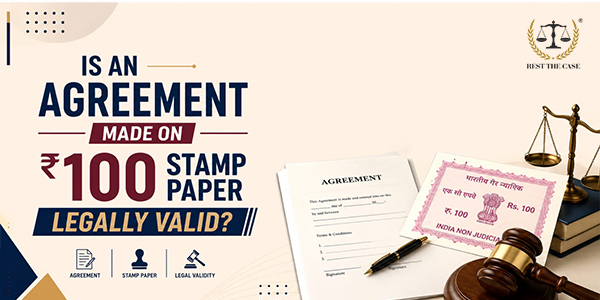
Is An Agreement Made On ₹100 Stamp Paper Legally Valid?

1.1. Why Stamp Paper Value Alone Does Not Decide Validity
1.2. The validity of agreement on stamp paper is governed by two separate legal tracks:
2. What Makes An Agreement Legally Valid In India? 3. Does The Value Of The Stamp Paper Determine The Validity Of An Agreement?3.1. This means that the stamp paper agreement India landscape is highly fragmented:
4. Is Registration Mandatory For Every Agreement?4.1. Agreements That Generally Require Registration
4.2. Agreements That May Not Require Registration
5. Is Notarization Necessary For A ₹100 Stamp Paper Agreement? 6. Can An Agreement On ₹100 Stamp Paper Be Enforced In Court?6.1. What Happens If The Agreement Is Executed On Insufficient Stamp Duty?
7. Key Comparisons: Clarifying Legal Concepts7.1. Stamp Paper vs Registration vs Notarization
7.2. Factors Affecting Legal Validity Of An Agreement
7.3. Common Mistakes People Make While Executing Agreements On Stamp Paper
8. How Can You Ensure Your Agreement Is Legally Strong? 9. ConclusionYes, an agreement on a ₹100 stamp paper can be legally valid, but there is a major catch: it depends entirely on the specific type of agreement. For basic contracts, like non-disclosure agreements (NDAs), service contracts, or short-term rental agreements, a ₹100 stamp is usually perfectly sufficient.
However, for high-value transactions like property sales, power of attorney, or long-term leases, ₹100 is legally insufficient. Each Indian state sets its own stamp duty rates. If a document is under-stamped, courts will reject it as primary evidence until you pay the deficit amount alongside a heavy penalty. To ensure full court recognition, the document must also be signed by both parties, witnessed, and officially registered if required. Always verify your local state laws before printing.
Is An Agreement Made On ₹100 Stamp Paper Legally Valid?
Yes, an agreement executed on a ₹100 stamp paper can be legally valid, provided that ₹100 is the correct amount of stamp duty prescribed by your specific state's laws for that particular type of agreement, and all other essential elements of a valid contract are met. For instance, simple contracts like non-disclosure agreements (NDAs), certain service level agreements, or short-term personal loan agreements may be perfectly valid on a ₹100 stamp paper in several states. However, for high-value transactions, property sales, or long-term leases, ₹100 stamp paper is legally insufficient.
Why Stamp Paper Value Alone Does Not Decide Validity
A common legal misconception in India is that the monetary value of the stamp paper acts as a universal shield of legitimacy. In reality, stamp duty is a form of tax levied by state governments on written instruments. The value of the stamp paper is simply a reflection of the tax paid.
The validity of agreement on stamp paper is governed by two separate legal tracks:
- Substantive Validity: Governed by the Indian Contract Act, 1872, which dictates whether the agreement contains the core elements of a legally binding contract (such as free consent, lawful object, and competent parties).
- Procedural Admissibility: Governed by the Indian Stamp Act, 1899 (along with respective state stamp acts) and the Registration Act, 1908, which dictate whether the correct tax has been paid and if the document has been officially recorded.
If an agreement fails to meet the substantive requirements of contract law, even a ₹10,000 stamp paper cannot make it valid. Conversely, if an agreement is substantively perfect but executed on an incorrect denomination, it becomes procedurally defective and cannot be easily used as evidence in court until rectified.
Read Also:
- Stamp Duty in India
- Stamp Duty On LLP Agreement In India : State-Wise & Calculation Guide
- Property Registration in India
What Makes An Agreement Legally Valid In India?
To build a legally sound foundation, every contract on ₹100 stamp paper must strictly adhere to the provisions of the Indian Contract Act, 1872. Section 10 of the Act outlines the mandatory contract legal requirements India enforces for an agreement to transform into an enforceable contract.
For any agreement or contract on stamp paper to be fully enforceable under the Indian Contract Act, 1872, it must meet these five essential requirements:
- Offer and Acceptance: The deal must start with a clear proposal from one side and an exact, unconditional agreement from the other side. Vague discussions do not count.
- Free Consent: Both sides must sign out of their own free will. The agreement is invalid if someone is forced, tricked, threatened, or lied to.
- Lawful Consideration: The exchange value, whether it is money, goods, or services, must be legal. You cannot legally contract to pay for something illegal or immoral.
- Competent Parties: The people signing must be legally qualified. This means they must be at least 18 years old, of sound mind, and not banned by law from signing contracts.
- Lawful Object: The actual purpose or goal of the agreement must be legal. If the contract is made to do something illegal, the entire document is instantly null and void.
Does The Value Of The Stamp Paper Determine The Validity Of An Agreement?
The legal value of ₹100 stamp paper varies drastically depending on where you are located and what transaction you are executing. Under the Constitution of India, stamp duties on documents (other than those specified in the Union List, like bills of exchange or insurance policies) fall under the Concurrent List, giving state governments the power to legislate their own stamp laws.
This means that the stamp paper agreement India landscape is highly fragmented:
- State-by-State Variations: Maharashtra (under the Maharashtra Stamp Act), Karnataka, Delhi, and Tamil Nadu all have distinct schedules outlining the exact stamp duty required for different instruments. What requires a ₹100 stamp paper in one state might require a ₹500 or percentage-based stamp duty in another.
- Nature of the Transaction: A ₹100 stamp paper is frequently used for simple undertakings, indemnity bonds, affidavits, or short-term agreements. However, if you attempt to execute a Power of Attorney (PoA), a partnership deed, or a share transfer agreement on a ₹100 stamp paper in a state where the statutory requirement is higher, the document is considered understamped.
Therefore, the denomination does not determine the psychological "strength" of the contract; rather, it determines whether you have legally complied with state fiscal laws.
Is Registration Mandatory For Every Agreement?
Another crucial pillar of ₹100 stamp paper legal validity is the Registration Act of 1908. Registration refers to the formal recording of a document with a designated government official (the Sub-Registrar). It provides public notice of the execution of the document, prevents fraud, and preserves a permanent public record.
Agreements That Generally Require Registration
Under Section 17 of the Registration Act, 1908, certain documents must be compulsorily registered. An unregistered agreement on stamp paper for these categories holds virtually no value for enforcing the primary transaction in court:
- Immovable Property Sales & Gifts: Any non-testamentary instrument that purports to create, assign, limit, or extinguish any right, title, or interest in immovable property valued at ₹100 or more.
- Long-Term Leases: Leases of immovable property from year to year, or for any term exceeding eleven months.
- Mortgages: Instruments securing a loan against immovable property.
Note on Property Transactions: If you sign an agreement to sell a flat or lease a commercial property for two years on a ₹100 stamp paper without registering it, the document cannot be used to prove your title or tenancy rights in court.
Agreements That May Not Require Registration
Section 18 of the Registration Act outlines documents for which registration is optional. These include:
- Short-Term Leases: Lease or rent agreements for a duration of up to 11 months. This is why 11-month residential rental agreements are widely executed on a ₹100 or ₹200 stamp paper without formal registration.
- Moveable Property Transactions: Agreements relating to the sale or hire of vehicles, machinery, or consumer goods.
- Promissory Notes and Simple Loan Agreements: Documents recording a personal cash loan without creating a charge or mortgage on property.
Is Notarization Necessary For A ₹100 Stamp Paper Agreement?
A common practice in India is to take a stamped agreement to a Notary Public to get it stamped with a notary seal and signed. It is critical to understand that notarization is not the same as registration, nor does it cure an under-stamped document.
The primary function of a Notary Public (governed by the Notaries Act, 1952) is to:
- Verify the true identity of the persons signing the document.
- Ensure that the parties are signing the document voluntarily without external duress.
- Certify that the signatures on the instrument are genuine.
While a notarized agreement's validity ensures that neither party can easily claim in court that their signature was forged or that they never signed the document, it does not pay your missing state tax (stamp duty) or satisfy the requirement for public recording (registration). A notarized agreement on a ₹100 stamp paper that legally required a ₹1,000 stamp duty and registration remains inadmissible as primary evidence in a legal dispute.
Can An Agreement On ₹100 Stamp Paper Be Enforced In Court?
If a legal dispute arises and you file a lawsuit based on your agreement, the court will evaluate the document under the rules of evidence. Under the Indian Evidence Act (and the updated Bharatiya Sakshya Adhiniyam framework), for any written contract to be admitted into evidence, it must be properly stamped according to the law in force when it was executed. If your contract belongs to a category where the state law mandates a ₹100 stamp duty (such as a simple commercial vendor contract or an 11-month lease in certain jurisdictions), the court validity of the stamp paper agreement is fully recognized. The judge will accept it as primary documentary evidence, and you can use it to enforce your contractual rights, claim damages, or seek specific performance. However, if the court finds that the document was executed on a ₹100 stamp paper to evade a higher applicable stamp duty, a legal roadblock occurs.
What Happens If The Agreement Is Executed On Insufficient Stamp Duty?
If an agreement is brought before a judge or an authorized public officer and is found to be insufficiently stamped, specific statutory provisions under the Indian Stamp Act agreement framework are triggered.
Admissibility In Evidence
Under Section 35 of the Indian Stamp Act, an instrument that is not duly stamped is strictly inadmissible in evidence. This means the court cannot look at the terms of the agreement, acknowledge the obligations written within it, or use it to grant you relief. The document is effectively frozen as an evidentiary tool.
Payment Of Deficit Stamp Duty And Penalty
An insufficiently stamped agreement is not permanently void; it suffers from a curable procedural defect. To make the agreement on stamp paper enforceable, the following process must take place:
- Impounding: The court or public authority will impound (seize) the document.
- Reference to the Collector: The document is sent to the Collector of Stamps to determine the exact deficit.
- Penalty Payment: The moving party will be required to pay the deficient stamp duty amount along with a statutory penalty. Under Section 35, this penalty can range up to ten times the value of the deficient stamp duty amount.
Once the deficit duty and the penalty are paid in full, the Collector endorses the document. Only after this endorsement does the agreement become admissible in court as valid evidence.
Key Comparisons: Clarifying Legal Concepts
To help you understand how these legal mechanisms interact, the following tables break down the distinct functions, requirements, and common misconceptions surrounding Indian agreement executions.
Stamp Paper vs Registration vs Notarization

Factors Affecting Legal Validity Of An Agreement
The image contains the following table:
- Free Consent: Both sides must agree freely without force (Indian Contract Act, 1872). If someone is forced into the deal, the wronged person can choose to cancel the agreement.
- Competent Parties: Everyone signing must be legally capable, like being of sound mind and the right age (Indian Contract Act, 1872). If not, the agreement is completely invalid from the very start.
- Lawful Consideration: The payment, trade, or exchange value must be legal (Indian Contract Act, 1872). If it involves something illegal, the agreement breaks the law and cannot be enforced.
- Lawful Object: The actual purpose or goal of the agreement must be legal (Indian Contract Act, 1872). If the goal is illegal, courts will not enforce it or help either side.
- Proper Stamp Duty: You must pay the correct state tax on the document (Indian Stamp Act, 1899). If you do not pay it, you cannot use the document as evidence in court until you pay the tax plus a penalty fine.
- Registration: Certain documents, like property deals, must be officially recorded (Registration Act, 1908). If you skip this, the document will not legally transfer the property and cannot be used as court evidence.
Common Mistakes People Make While Executing Agreements On Stamp Paper
Even when individuals act in good faith, simple errors during the execution phase can severely compromise the legal standing of a document.
Using Incorrect Stamp Duty: Many people assume a ₹100 stamp paper is enough for every agreement. However, stamp duty depends on the document type and state laws. Using the wrong stamp duty can make the document defective.
Assuming Registration Is Never Required: Some people believe registration is optional. But leases for more than 11 months and certain other documents must be registered. Without registration, the document may have limited legal value in court.
Leaving Blank Spaces: Never sign an agreement with blank spaces or missing details. These can be misused later and may lead to legal disputes.
Failing to Properly Identify the Parties: An agreement should clearly mention each party's full name, ID details (such as PAN, Aadhaar, or CIN), and complete address. Incomplete information can create legal issues.
How Can You Ensure Your Agreement Is Legally Strong?
To avoid structural vulnerabilities and ensure your document will hold up under close judicial scrutiny, follow these best practices when drafting and executing your agreement:
- Verify State Stamp Duty: Check your state's stamp duty rules before buying stamp paper. Use the correct value for your document.
- Use Clear Language: Write simple and clear terms covering rights, payment, timelines, dispute resolution, and termination.
- Have Two Witnesses: Get two independent witnesses to sign the agreement with their full names and addresses.
- Register When Required: Register agreements involving property sale, transfer, or leases exceeding the legal limit.
- Sign Every Page: All parties should sign the last page and initial every other page to prevent alterations.
Conclusion
When buying property, even small details matter. If you see the abbreviation "POI" in a Delhi land record, there is usually no need to worry. In most cases, it is a procedural note showing that identity verification was completed during registration. However, abbreviations can differ across departments and records. So, never rely on assumptions. Always verify the title, check municipal and revenue records, and consult a property lawyer to ensure the property is legally clear and free from hidden issues.
Disclaimer: This blog is for informational purposes only. If you need legal consultation, please contact an experienced civil lawyer.
Frequently Asked Questions
Q1. Is an agreement on ₹100 stamp paper legally valid?
Yes, it is legally valid provided that ₹100 is the correct amount of stamp duty prescribed by the respective state government for that specific category of agreement, and the contract fulfills all essential criteria under the Indian Contract Act, 1872.
Q2. Does higher-value stamp paper make an agreement stronger?
No. A higher-value stamp paper does not add extra legal weight to an agreement. It only satisfies the fiscal tax requirements of the state. If the contract lacks core legal elements like free consent or a lawful object, it remains invalid regardless of how expensive the stamp paper is.
Q3. Can a handwritten agreement on ₹100 stamp paper be valid?
Yes, Indian law recognizes handwritten agreements on valid stamp papers, provided they are legible, signed voluntarily by competent parties, properly stamped, and contain all the essential elements of a valid contract.
Q4. Is registration compulsory for every agreement?
No, registration is not compulsory for every agreement. It is only mandatory for specific documents listed under Section 17 of the Registration Act, 1908, such as sale deeds for immovable property and lease agreements that exceed a duration of 11 months.
Q5. Is notarization mandatory?
No, notarization is generally not mandatory unless specified by a particular rule or institutional requirement (such as certain affidavits, power of attorneys, or bank loan undertakings). It simply serves as authentic evidence that the signatures on the document are genuine.

 Get Expert Advice and Solutions
Experienced lawyers for all legal matters wether it is for Family, Property, Criminal Cases, and More
Consult Now