


Business & Compliance
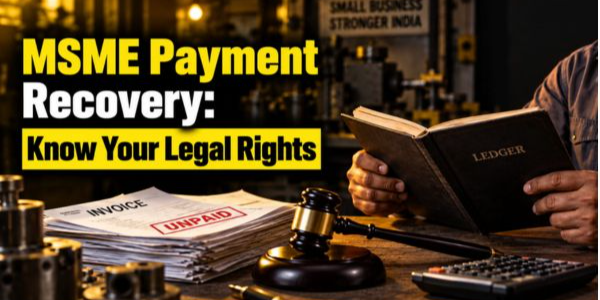
MSME Payment Recovery: Know Your Legal Rights

2.3. Mandatory Udyam Registration
2.4. Important Eligibility Nuance
3. How Long Can a Buyer Take to Pay an MSME? 4. Can an MSME Claim Interest on Delayed Payments? 5. How Can an MSME Recover Unpaid Payments Through the MSEFC? 6. What Is MSME Samadhaan and How Does It Help?6.1. How Samadhaan Simplifies the Process:
7. What Documents Are Required for MSME Payment Recovery?7.1. Primary Documents Required:
8. What If the Buyer Disputes the Invoice or Quality of Goods or Services?8.1. How Disputes Are Handled:
9. Can an MSME Take Other Legal Action for Unpaid Payments? 10. What Happens If the Buyer Challenges an MSEFC Award?10.1. Mandatory 75% Pre-Deposit Requirement
10.2. Why This Protection Matters:
11. What Should An MSME Do Before Starting Payment Recovery Proceedings? 12. How Can MSMEs Prevent Payment Delays in the Future? 13. MSME Payment Recovery Checklist 14. ConclusionIf a buyer delays payment to an eligible Micro or Small Enterprise, the MSMED Act, 2006 provides specific legal remedies. Depending on the circumstances, an eligible MSME may claim the outstanding amount, delayed-payment interest and approach the Micro and Small Enterprises Facilitation Council (MSEFC) for recovery through conciliation and arbitration.
What Are Your Legal Rights When a Buyer Delays Payment?
When you supply goods or render services to a buyer, you are legally entitled to receive your payment on time. The MSMED Act, 2006 (Sections 15 to 19) gives micro and small suppliers direct legal protection against unpaid invoices.
- Right to Timely Payment: Buyers are required by law to clear your invoice within the agreed credit period or the statutory maximum limit.
- Maximum 45-Day Cap: Even if a buyer asks for 60 or 90 days of credit, the law caps the maximum credit period at 45 days if there is a written agreement.
- Right to Statutory Interest: If the buyer delays payment beyond the due date, they are legally liable to pay heavy compound interest on the delayed amount.
- Access to Special Dispute Resolution: You do not have to fight long, expensive civil court battles right away. You can directly approach the Micro and Small Enterprises Facilitation Council (MSEFC).
- Conciliation and Arbitration: The MSEFC provides an organized two-step process, first trying to resolve the dispute through friendly conciliation, and if that fails, moving directly to binding arbitration.
- Enforceable Awards: An order passed by the MSEFC has the same legal power as a civil court decree and can be enforced directly through legal execution proceedings.
Who Can Claim MSME Payment Protection?
Not every business in India gets automatic coverage under the MSME delayed payment recovery framework. The law is specifically designed to protect Micro and Small Enterprises.
Enterprise Category
- Micro Enterprises: Investment in plant and machinery/equipment up to ₹1 Crore and annual turnover up to ₹5 Crores.
- Small Enterprises: Investment up to ₹10 Crores and annual turnover up to ₹50 Crores.
- Medium Enterprises: Medium enterprises are generally not eligible to file delayed payment recovery applications before the MSEFC under Section 18 of the MSMED Act.
Supplier Status
You must be a "supplier" who has provided goods or rendered services to a buyer. Both manufacturing enterprises and service providers are covered under this protection.
Mandatory Udyam Registration
Having a valid Udyam Registration is essential. Registration acts as official proof that your business falls under the micro or small category.
Important Eligibility Nuance
It is vital to understand that simply holding an Udyam Certificate today does not automatically guarantee delayed-payment protection for every old transaction. The timing of your registration and the nature of your business activity play a crucial role. Courts have repeatedly held that to claim benefit under the MSMED Act for a specific transaction, the supplier should ideally hold valid MSME registration at the time of supplying the goods or rendering the services. Always check your registration dates and activity classification before initiating legal recovery.
How Long Can a Buyer Take to Pay an MSME?
Section 15 of the MSMED Act, 2006 lays down strict boundaries for payment terms to keep buyers from exploiting small suppliers.
- With a Written Agreement: If you have a written contract, purchase order, or agreement mentioning payment terms, the buyer must pay you within the agreed timeline. However, even if the written agreement says 60, 90, or 120 days, the law limits the maximum payment period to 45 days.
- Without a Written Agreement: If there is no written contract specifying credit terms, the buyer must clear the payment within 15 days from the "day of acceptance" or "day of deemed acceptance."
- Day of Acceptance / Deemed Acceptance: This refers to the actual date the buyer receives the goods/services. If the buyer has any objection regarding quality or quantity, they must raise it in writing within 15 days of delivery. If no objection is raised in writing within 15 days, the delivery is legally considered "deemed accepted."
Can an MSME Claim Interest on Delayed Payments?
Yes. Sections 16 and 17 of the MSMED Act provide a strong financial safeguard against delayed payments by imposing mandatory statutory interest on buyers.
- Statutory Interest Rate: If a buyer fails to pay within the 15-day or 45-day window, they must pay interest to the supplier on the outstanding balance. The statutory interest rate under Section 16 is fixed at three times the Bank Rate notified by the Reserve Bank of India (RBI).
- Monthly Compound Interest: Unlike standard bank loans or normal commercial debts, interest under the MSMED Act is calculated as compound interest with monthly rests. This means unpaid interest gets added to the principal balance every month, causing the interest amount to grow quickly over time.
- Non-Deductible Expense: To make this penalty even stronger, Section 23 of the Act specifies that the interest paid by a buyer for delayed MSME payments cannot be claimed as a tax-deductible expense under the Income Tax Act, 1961. This creates a real financial incentive for buyers to clear dues on time.
Because statutory interest rates fluctuate with RBI bank rate updates, you should always double-check exact calculations with a financial professional or lawyer before submitting your legal claim.
How Can an MSME Recover Unpaid Payments Through the MSEFC?
Section 18 of the MSMED Act lays down a step-by-step recovery process through the Micro and Small Enterprises Facilitation Council (MSEFC).
- Step 1: Identify Unpaid Invoices - List out all pending invoices that have crossed either the 15-day limit (without an agreement) or the 45-day limit (with an agreement).
- Step 2: Verify Eligibility - Ensure your Udyam Registration was active and valid during the transaction period and that your business qualifies as a Micro or Small enterprise.
- Step 3: Collect Transaction Documents - Assemble all purchase orders, tax invoices, delivery challans, transport receipts, email communications, and payment reminder letters.
- Step 4: Calculate the Claim - Prepare a clear statement showing the principal unpaid amount and the exact delayed-payment interest calculated under Section 16.
- Step 5: File a Reference - Submit an application online through the MSME Samadhaan portal or directly to your local state MSEFC council.
- Step 6: Conciliation Proceedings - Once the reference is accepted, the MSEFC will issue notice to the buyer and try to resolve the dispute through friendly conciliation. If the buyer agrees to pay, a settlement agreement is signed.
- Step 7: Arbitration Proceedings - If conciliation fails or the buyer refuses to participate, the Council terminates conciliation and takes up the dispute for arbitration itself, or refers it to an arbitration center. After hearing both sides, the arbitrator passes a final, legally binding Arbitration Award.
- Step 8: Award Enforcement - If the buyer refuses to pay even after an award is passed against them, you can file an execution application in the local civil court to recover the money by attaching their bank accounts or business assets.
What Is MSME Samadhaan and How Does It Help?
MSME Samadhaan is an online portal launched by the Ministry of Micro, Small and Medium Enterprises. It acts as an easy digital gateway for small suppliers to log delayed payment applications.
How Samadhaan Simplifies the Process:
- Online Filing: You do not need to physically visit offices to lodge an initial application. You can log in using your Udyam Registration number and upload digital copies of your invoices.
- System Notices: Upon filing, the portal automatically sends an electronic alert or preliminary notification to the buyer, giving them a chance to settle the matter early.
- Application Tracking: You can monitor the real-time status of your application online, from submission to conversion into an official Council case.
- Seamless Routing: Once submitted, the application is automatically directed to the designated MSEFC in the state where your enterprise is registered.
What Documents Are Required for MSME Payment Recovery?
To secure a favorable order from the MSEFC or an arbitrator, you need clear documentary evidence. You must prove two main points: that you delivered the goods or services properly, and that the payment remains unpaid.
Primary Documents Required:
- Udyam Registration Certificate: Proves your eligibility as a Micro/Small enterprise.
- Purchase Order (PO) or Contract: Shows the agreed commercial terms, price, and credit conditions.
- Tax Invoices: Detailed copies of all unpaid invoices showing the due dates.
- Proof of Delivery / Service Completion: Signed delivery challans, lorry receipts (LR), transporter consignment notes, or work completion sign-offs.
- Statement of Accounts / Ledger: A clean ledger extract showing historical payments received and the exact balance outstanding.
- Written Communication & Reminders: Copies of emails, WhatsApp messages, or formal legal notices asking the buyer to clear the pending dues.
Also Read: Are WhatsApp Agreements Legally Valid In India?
What If the Buyer Disputes the Invoice or Quality of Goods or Services?
Buyers often try to avoid payment by raising objections about the quality, quantity, or delivery timelines of goods or services. An unpaid invoice does not lead to an automatic decision in your favor if the buyer presents a genuine commercial dispute.
How Disputes Are Handled:
- The 15-Day Objection Rule: Under the MSMED Act, if a buyer has issues with quality or delivery, they are required to raise a written objection within 15 days of delivery. If they stayed silent for months and only complained after you asked for payment, the council will view their defense with skepticism.
- Examination of Records: During conciliation or arbitration, the council will examine inspection reports, email trails, and delivery records.
- Evidence-Based Adjudication: If the buyer proves that goods were genuinely defective or returned, the arbitrator will adjust the claim amount accordingly. If the objection turns out to be a delaying tactic, the full claim plus statutory interest will be awarded.
Can an MSME Take Other Legal Action for Unpaid Payments?
While filing a reference before the MSEFC is generally the most effective remedy, it is not your only option.
Legal Route | When to Use | Key Feature |
|---|---|---|
Legal Demand Notice | First formal step before starting any legal proceeding. | Gives the buyer a final 7 to 15-day warning to settle out of court. |
MSEFC Reference (MSMED Act) | Best for Micro & Small enterprises with valid Udyam. | Provides statutory interest and two-stage dispute resolution. |
Summary Suit (Order 37, CPC) | When you have clear, written contracts/invoices and no complex dispute. | Fast-track civil suit where the defendant must seek leave to defend. |
Cheque Dishonour (Sec. 138, NI Act) | When a cheque issued by the buyer bounces due to insufficient funds. | Criminal remedy that carries potential imprisonment or fines. |
Insolvency Proceedings (IBC) | For operational debts above ₹1 Crore against corporate buyers. | Severe pressure point that can trigger corporate insolvency against a company. |
What Happens If the Buyer Challenges an MSEFC Award?
If the MSEFC passes an arbitration award in your favor, a buyer may try to challenge it in court to delay payment. However, Section 19 of the MSMED Act places a major restriction on buyers trying to derail an award.
Mandatory 75% Pre-Deposit Requirement
Under Section 19 of the MSMED Act, no court will entertain an application filed by a buyer to set aside an MSEFC award unless the buyer first deposits 75% of the awarded amount with the court.
Why This Protection Matters:
- Deters Frivolous Appeals: Buyers cannot easily stall enforcement by filing baseless legal appeals because they have to block 75% of the money upfront.
- Interim Relief for MSMEs: Section 19 also empowers the court to release a portion of this deposited amount to the MSME supplier during the pendency of the appeal, subject to terms specified by the court.
What Should An MSME Do Before Starting Payment Recovery Proceedings?
Before launching formal legal action or submitting an application on the Samadhaan portal, follow this practical step-by-step checklist to make sure your case is solid:
- Reconcile Accounts: Ensure your account entries match the buyer's payment history accurately.
- Verify Due Dates: Confirm whether payment has crossed 15 days (without a contract) or 45 days (with a written contract).
- Check MSME Eligibility: Confirm your Udyam Certificate was valid at the time of supply and covers the relevant goods/services.
- Compile Paperwork: Organize POs, invoices, transport receipts, signed delivery notes, and email records into a clear file.
- Send a Formal Demand Notice: Send a written payment reminder or legal notice giving the buyer a clear 7-to-15-day timeline to pay.
- Calculate Interest: Calculate statutory interest under Section 16 up to the present date using applicable RBI bank rates.
- Submit File to MSEFC: If the buyer fails to respond, submit your application on the MSME Samadhaan portal.
How Can MSMEs Prevent Payment Delays in the Future?
While legal remedies exist, preventing payment delays before they happen is always better for business cash flow. Here are practical steps to protect your receivables:
- Insist on Written Contracts: Avoid verbal orders. Always demand a signed Purchase Order or formal contract clearly stating credit timelines (keep them under 45 days).
- Include Late-Payment Clauses: Print explicit clauses on your invoices mentioning that delayed payments will attract compound interest under the MSMED Act, 2006.
- Collect Proof of Delivery: Never deliver goods without obtaining a clear, stamped delivery receipt or signed lorry receipt (LR).
- Invoice Immediately: Send your tax invoices along with delivery or right after completing a service.
- Set Up Debtor Ageing Reports: Track your receivables weekly using accounting software so you can follow up on overdue bills as soon as they cross 15 or 30 days.
- Address Complaints In Writing: If a buyer raises a verbal quality issue, immediately reply via email asking for written details within 15 days to protect your legal position under Section 15.
MSME Payment Recovery Checklist
Step | What to Check |
|---|---|
Eligibility | Confirm Micro or Small enterprise classification. |
Registration | Keep Udyam Registration Certificate ready. |
Transaction | Collect Purchase Orders, work orders, or agreements. |
Invoice | Verify unpaid tax invoices and track exact due dates. |
Evidence | Gather delivery challans, LRs, or service completion proof. |
Due Date | Check if the delay exceeds 15 days (no agreement) or 45 days. |
Interest | Calculate statutory compound interest under Section 16. |
Communication | Preserve email reminders, WhatsApp chats, and notice receipts. |
MSEFC Filing | Submit an application on the online MSME Samadhaan portal. |
Tracking | Monitor conciliation, arbitration, and final award enforcement. |
Conclusion
MSMEs have strong legal protection when buyers delay payments. Businesses should first verify their Udyam registration, unpaid invoices, payment terms, and supporting documents. If payment remains pending, they can send a legal notice and approach the MSME Samadhaan portal or MSEFC for recovery. Statutory interest can also be claimed on delayed payments. Keeping proper records and acting within the applicable timelines can make recovery smoother, protect cash flow, and help businesses handle payment disputes more confidently.
Disclaimer: This blog is for informational purposes only. If you require legal consultation, kindly contact an experienced Corporate Lawyer.
Frequently Asked Questions
Q1. What is the maximum payment period for MSMEs in India?
Under Section 15 of the MSMED Act, the maximum credit period a buyer can take is 45 days if there is a written agreement. If there is no written agreement, payment must be made within 15 days of delivery.
Q2. Can an MSME claim interest on delayed payments?
Yes. Section 16 of the MSMED Act mandates that delayed payments attract compound interest with monthly rests at three times the RBI notified Bank Rate.
Q3. Who can file an MSME payment recovery case?
Any Micro or Small enterprise holding valid Udyam Registration that has supplied goods or rendered services to a buyer can file a delayed payment reference.
Q4. Is Udyam registration required for MSME payment recovery?
Yes, valid Udyam Registration is essential to access recovery remedies through the MSEFC and the MSME Samadhaan portal.
Q5. Can service providers recover delayed payments under the MSMED Act?
Yes. Both manufacturing enterprises and service-providing enterprises falling under the Micro and Small categories are fully covered under the MSMED Act.

 Get Expert Advice and Solutions
Experienced lawyers for all legal matters wether it is for Family, Property, Criminal Cases, and More
Consult Now