


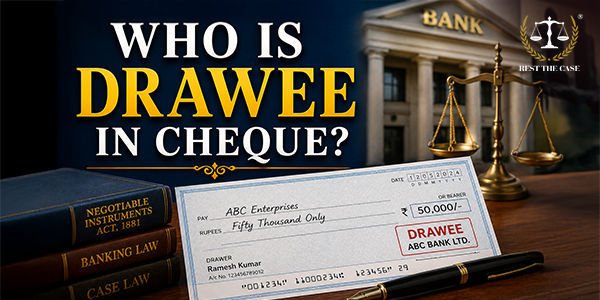

The drawee in a cheque is the bank that is directed by the account holder to pay the specified amount to the named recipient. Every cheque transaction involves three parties — the drawer (account holder who writes the cheque), the drawee (bank on which the cheque is drawn), and the payee (person entitled to receive the money). Understanding who the drawee is matters in everyday banking, cheque bounce litigation, and competitive exams covering the Negotiable Instruments Act, 1881.
What Is A Drawee In A Cheque?
A drawee is the party instructed to make payment. In the context of a cheque, the drawee is always the bank at which the drawer maintains an account. When a cheque is issued, it is essentially a written order from the account holder directing their bank to pay a specified sum to a named person or bearer on demand. The bank does not decide whether to pay of its own will — it acts on the instruction embedded in the cheque, subject to verification of account balance, signature, and instrument validity.
Under the Negotiable Instruments Act, 1881, Section 7 defines a drawee as the person directed by the drawer to pay. Section 6 separately defines a cheque as a bill of exchange drawn on a specified banker, and payable on demand. The phrase 'drawn on a specified banker' is precisely what makes the bank the drawee in a cheque — no other entity can occupy that role in this instrument.
Quick example: Rahul holds a savings account with State Bank of India, Andheri branch. He writes a cheque of Rs. 25,000 in favour of Priya. Here, Rahul is the drawer, State Bank of India is the drawee, and Priya is the payee.
Who Are The Three Parties In A Cheque?
A cheque is a tripartite instrument. Each party carries a distinct legal identity and responsibility.
The drawer is the account holder who creates and signs the cheque. By signing, the drawer authorises the drawee bank to debit the specified amount from their account. The drawer is primarily liable if the cheque is dishonoured.
The drawee is the bank. Its role is reactive — it does not initiate payment but responds to the instruction on the cheque. The bank verifies the instrument, checks the account, and either honours or dishonours the cheque.
The payee is the person named on the cheque as the recipient of funds. The payee presents the cheque for payment, either at their own bank or directly at the drawee bank.
Party | Who It Is | Role |
Drawer | Account holder | Issues the cheque |
Drawee | Bank | Pays the cheque amount |
Payee | Recipient | Receives the payment |
How Does A Drawee Bank Process A Cheque?
Once a cheque is presented for payment — either over the counter or through the clearing system — the drawee bank follows a structured verification process before releasing funds.
- Signature verification: The bank matches the drawer's signature on the cheque against the specimen on file.
- Account balance check: The bank confirms that the drawer's account holds sufficient funds to cover the cheque amount.
- Instrument validity: The bank checks that the cheque is within its validity period (three months from date of issue), that no alterations exist, and that the MICR and account details are consistent.
- Payment or dishonour: If all checks pass, the bank debits the drawer's account and credits the payee's account. If any check fails, the cheque is returned with a return memo stating the reason for dishonour.
This process happens within the clearing cycle managed through the RBI's Cheque Truncation System (CTS), where physical cheques are scanned and processed electronically rather than physically moved between banks
Is The Drawee Always A Bank?
In a cheque, yes — the drawee is always and exclusively a bank. This is a statutory requirement. Section 6 of the Negotiable Instruments Act specifies that a cheque must be drawn on a specified banker. This distinguishes a cheque from other negotiable instruments such as a bill of exchange, where the drawee can be any person or entity — an individual, a firm, or a company.
If a document resembling a cheque is drawn on anyone other than a bank, it does not qualify as a cheque under Indian law. It may be treated as a bill of exchange, but the legal consequences — including those under Section 138 for dishonour — would not apply to it as they would to a cheque. This distinction is frequently tested in banking service exams and legal proceedings.
What Is The Difference Between Drawee And Payee?
The drawee and the payee are among the most commonly confused terms in cheque-related discussions. The confusion arises because both appear on the face of the cheque — the bank's name is typically pre-printed, while the payee's name is written by the drawer. However, their roles are fundamentally different.
The drawee (bank) makes the payment. The payee receives it. The drawee holds no money of its own in this transaction — it merely disburses funds from the drawer's account. The payee is the intended beneficiary who presents the cheque and receives the funds.
Basis | Drawee | Payee |
Identity | Bank | Person receiving money |
Receives Payment | No | Yes |
Named On Cheque | Pre-printed bank details | Written by drawer |
Legal Role | Makes payment | Gets payment |
What Are The Responsibilities Of A Drawee Bank?
The drawee bank carries specific obligations under banking law and the Negotiable Instruments Act. Its primary duty is to honour a cheque whenever the instrument is valid and the account holds sufficient funds. Beyond that, the bank is responsible for several safeguards:
- Verify the authenticity of the instrument, including signature and date.
- Ensure the cheque has not been materially altered.
- Refuse payment on post-dated cheques before the date of issue.
- Act on stop-payment instructions received from the drawer before the cheque is presented.
- Return dishonoured cheques with a formal return memo specifying the reason.
The bank does not bear liability for the underlying transaction between the drawer and payee. Its obligation is purely transactional — to verify and execute the payment instruction as per the cheque.
When Can A Drawee Bank Refuse To Honour A Cheque?
A drawee bank is legally permitted - and in certain situations obligated — to refuse payment. Wrongful dishonour exposes the bank to liability, but dishonour on valid grounds is protected. The most common grounds for refusal are:
Reason | Meaning |
|---|---|
Insufficient Funds | The account balance is lower than the cheque amount |
Signature Mismatch | The signature on the cheque differs from the specimen on file |
Stale Cheque | The cheque is presented after the three-month validity window |
Stop Payment Instruction | The drawer has formally directed the bank not to honour the cheque |
Account Closed or Frozen | The drawer's account is no longer active or has been restricted |
Material Alteration | The cheque shows signs of tampering or unauthorised changes |
What Is The Role Of The Drawee In A Cheque Bounce Case?
When a cheque is dishonoured, the drawee bank plays a procedural but critical role. The bank returns the cheque to the payee's bank (or directly to the payee if presented over the counter) along with a return memo. This memo specifies the reason for dishonour- for example, 'funds insufficient' or 'account closed'. The return memo from the drawee bank is the foundational document in a Section 138 proceeding under the Negotiable Instruments Act. The payee relies on this memo to issue a statutory demand notice to the drawer. If the drawer fails to make payment within 15 days of receiving the notice, the payee can file a criminal complaint. It is important to note that the drawee bank itself is not a party to the Section 138 case and bears no criminal or civil liability for the dishonour - unless the dishonour was a result of the bank's own wrongful act, such as refusing to pay despite adequate funds being available.
How Can You Identify The Drawee On A Cheque?
The drawee bank is identifiable from details that are pre-printed on the cheque leaf itself. Modern cheques issued under CTS (Cheque Truncation System) standards carry the following information about the drawee:
- Bank name and branch address: Printed at the top or bottom of the cheque leaf.
- IFSC code: The 11-character alphanumeric code identifying the specific branch for electronic fund transfers.
- MICR code: The 9-digit Magnetic Ink Character Recognition code printed at the bottom of the cheque in a distinct font, used for automated cheque processing.
These identifiers collectively point to the drawee bank and branch. The MICR code in particular carries the city code, bank code, and branch code — making it the most precise identifier of the drawee in the cheque clearing system.
Related Readings:
Court Fees For Cheque Bounce Case In India : A Complete Guide
How To File A Police Complaint For Cheque Bounce In India
Conclusion
The drawee in a cheque is the bank instructed by the account holder to pay the specified amount from their account to the named payee. It is always a bank- this is a statutory requirement under Section 6 of the Negotiable Instruments Act, 1881. The drawee sits at the centre of every cheque transaction: it verifies the instrument, checks account conditions, and either honours or dishonors the cheque, issuing a return memo in the latter case. Understanding the distinction between the drawer (who issues), the drawee (the bank that pays), and the payee (who receives) is foundational for anyone dealing with banking transactions, cheque clearance procedures, or disputes under Section 138 of the Negotiable Instruments Act.
Disclaimer: This article offers general guidance on the Negotiable Instruments Act and the role of a drawee bank, not formal legal advice. For specific cheque bounce disputes, please consult an expert criminal lawyer regarding Section 138 proceedings or a civil lawyer for money recovery.
Frequently Asked Questions
Q1. Is the drawee always a bank?
Yes. Under Section 6 of the Negotiable Instruments Act, 1881, a cheque must be drawn on a specified banker. The drawee in a check is always a bank, no other entity can occupy this role.
Q2. How can I identify the drawee on a cheque?
The bank's name and branch are pre-printed on the cheque leaf. The IFSC and MICR codes at the bottom of the cheque further identify the specific drawee branch.
Q3. Can the drawee and payee be the same?
No. The drawee is the bank that pays; the payee is the person who receives. These are distinct roles. However, if someone deposits a cheque into their own account at the drawee bank, both transactions involve the same bank, but the bank's roles as drawee and as the payee's account holder are still legally separate functions.
Q4. What happens if the drawee bank refuses payment?
The bank issues a return memo specifying the reason for dishonour. The payee can then use this memo to initiate legal proceedings against the drawer under Section 138 of the Negotiable Instruments Act after issuing a statutory demand notice.
Q5. Is the drawee responsible for a cheque bounce?
No. In a standard cheque bounce case under Section 138, liability rests with the drawer. The drawee bank is not a party to the case unless the dishonour was caused by the bank's own wrongful act, such as refusing to honour a cheque despite adequate funds in the account.

 Get Expert Advice and Solutions
Experienced lawyers for all legal matters wether it is for Family, Property, Criminal Cases, and More
Consult Now