


Business & Compliance
Can A Founder Hold Shares In A Startup Through Holding Company?
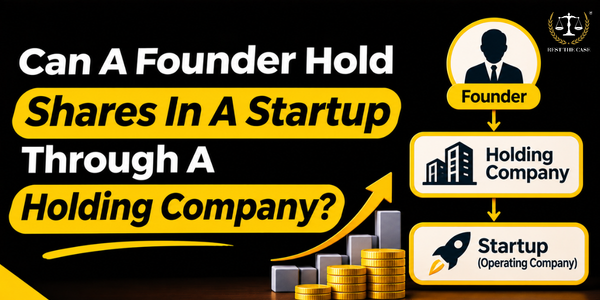

When you start a company in India, the easiest way to own shares is to hold them in your personal name. Many founders choose to hold their startup shares through a separate company. This arrangement is commonly known as a holding company structure. It allows a founder to own a company that, in turn, owns shares in one or more startups. Before choosing it, founders should understand how it works, its benefits, costs, and possible legal complications.
Can a Founder Hold Startup Shares Through a Holding Company?
Yes. A founder can hold shares in a startup through another company, commonly called a holding company or HoldCo. There are two common ways to hold shares:
- Direct Shareholding: In direct shareholding, the founder personally purchases or subscribes to shares in the startup. The founder's name is entered in the company's Register of Members.
- Indirect Shareholding: In indirect shareholding, the founder first owns shares in a separate company.
How Does a Holding Company Structure Work?
A holding company is generally created to own shares, intellectual property, investments, or other valuable assets. The basic ownership structure looks like this:
Founder → Holding Company → Startup (Operating Company)
Each level has a different role.
- Ownership: The founder owns shares in the holding company, while the holding company owns shares in the startup.
- Voting rights: The holding company votes at the startup's shareholder meetings. If the founder controls the holding company, the founder can generally influence how it exercises those voting rights.
- Dividends: If the startup declares a dividend, the payment goes to the holding company. The founder receives money personally only when the holding company distributes it through a legally permitted method, such as declaring its own dividend.
- Control: The founder controls the holding company, and the holding company exercises its shareholder rights in the startup.
Why Do Founders Hold Startup Shares Through a Holding Company?
A holding company may not be necessary when someone is starting a single small business. It creates additional paperwork, compliance requirements, and costs.
- Easier Management of Multiple Investments: An entrepreneur who invests in several startups may find it difficult to manage each investment personally. A holding company provides a single structure for holding different shareholdings.
- Support for Business Expansion: A holding company can make it easier to create new subsidiaries or group companies when the business expands.
- Better Investment Planning: A holding company can receive dividends or sale proceeds from its investments and use the available funds for other business opportunities.
- Succession Planning: Founders may also use a holding company to plan the transfer of business ownership to family members or future generations.
- Separation of Business Assets and Operations: Some business groups keep valuable assets, such as intellectual property, real estate, or cash reserves, separate from the company handling daily operations.
Holding Shares Directly vs. Through a Holding Company
Basis | Direct Shareholding | Holding Company Structure |
|---|---|---|
Registered shareholder | Individual founder | Holding company |
Ownership | Direct | Indirect |
Voting rights | Exercised by the founder | Exercised by the holding company |
Dividends | Paid to the founder | Paid to the holding company first |
Compliance | Comparatively simple | Additional company-level compliance |
Administration | Lower cost and paperwork | More paperwork and expenses |
Investment management | Managed personally | Can be managed through one entity |
What Are the Legal Requirements for Holding Startup Shares Through Another Company?
In India, company ownership is mainly governed by the Companies Act, 2013. The law requires companies to maintain proper ownership records and disclose beneficial ownership where applicable.
- Register of Members: Every company must maintain a Register of Members containing details of its shareholders. If a holding company purchases or subscribes to shares in a startup, the startup must record the holding company's name, registered office, and shareholding details in its statutory records.
- Declaration of Beneficial Interest Under Section 89: Sometimes, the person whose name appears in the company's records is different from the person who holds the beneficial interest in the shares. Section 89 of the Companies Act, 2013, deals with situations where registered ownership and beneficial ownership are held by different persons. However, a holding company owning shares in its own right does not automatically mean that Section 89 applies.
- Significant Beneficial Ownership Under Section 90: Even when a holding company is the legal shareholder, the government may require the startup to identify the individuals who ultimately own or control it. Section 90 of the Companies Act, 2013, read with the Companies (Significant Beneficial Owners) Rules, 2018, deals with Significant Beneficial Owners (SBOs).
An individual may generally qualify as an SBO if they hold, directly or indirectly, at least 10% of the shares, voting rights, or rights to receive distributable dividends in the reporting company, or exercise significant influence or control, subject to the detailed rules.
What Is the Difference Between a Holding Company and a Subsidiary Company?
The terms holding company and subsidiary company are often used when discussing business groups. However, they have specific legal meanings under the Companies Act, 2013. Sections 2(46) and 2(87) explain the relationship between holding companies and subsidiaries. A company becomes a subsidiary of another company when the other company:
- Controls the composition of its Board of Directors; or
- Exercises or controls more than half of its total voting power, either on its own or together with one or more of its subsidiary companies.
What Are the Tax Implications of Holding Startup Shares Through a Holding Company?
The Income-tax Act, 1961, contains provisions dealing with dividends, capital gains, and share transfers.
- Tax on Dividends
In India, dividends are generally taxable in the hands of the recipient. If a startup declares a dividend and pays it to its holding company, the dividend becomes taxable income of the holding company. However, Section 80M of the Income-tax Act provides a deduction in certain cases where a domestic company receives dividends from another domestic company and further distributes the dividend to its shareholders within the prescribed period.
- Capital Gains When the Holding Company Sells Startup Shares
Suppose the holding company sells its shares in a startup to an investor or another company. The profit from the sale is generally treated as capital gains in the hands of the holding company. The applicable tax rate depends on factors such as the type of shares, whether they are listed or unlisted, and the period for which they were held.
- Transferring Existing Shares to a Holding Company
Some founders initially hold startup shares personally and decide to transfer them to a holding company at a later stage. This transfer should be planned carefully because it may be treated as a taxable transfer under income-tax law.
What Happens When a Founder Sells or Transfers Shares Held Through a Holding Company?
A founder may assume that they can freely sell shares in their holding company because the holding company, rather than the founder, is the registered shareholder of the startup.
- Selling Holding Company Shares vs. Startup Shares
When a founder sells shares in the holding company, the holding company continues to appear as the shareholder of the startup. However, the buyer may acquire control over the holding company and indirectly gain control over the startup shares held by it.
- Shareholders' Agreement and Articles of Association
A startup's Shareholders' Agreement (SHA) and Articles of Associa
tion (AoA) may contain restrictions on direct and indirect share transfers. Before selling or transferring shares in the holding company, founders should review these documents carefully.
What Should Founders Check Before Creating a Holding Company?
- Identify the purpose: Decide why you need a holding company. It may be for managing multiple investments, expanding into different businesses, or planning succession.
- Review the startup's AoA and SHA: Check whether the existing documents allow a holding company to become a shareholder. Also look for restrictions on indirect transfers, founder lock-ins, and changes in control.
- Obtain investor approval: If the startup already has angel investors or venture capital funds, check whether their written consent is required before transferring shares to a holding company.
- Incorporate the holding company: Complete the required incorporation process with the Ministry of Corporate Affairs (MCA). Its constitutional documents should permit the proposed investment activities.
- Open a separate bank account: The holding company should maintain its own bank account and financial records.
- Maintain ownership documents: Keep proper board resolutions, share subscription agreements, share certificates, and other records at both the holding company and startup levels.
- Complete beneficial ownership disclosures: Check whether declarations under Sections 89 and 90 are required. Complete the relevant forms, including BEN-1 and BEN-2, wherever applicable.
- Review tax and FEMA requirements: Take professional advice before transferring existing shares or dealing with foreign shareholders and investments. FEMA and RBI rules may apply to foreign investment and downstream investment by Indian entities with foreign ownership.
- Plan for ongoing compliance: A holding company has its own compliance responsibilities, including applicable audits, income-tax returns, annual RoC filings, and board meetings.
Legal Framework Governing Founder Holding Structures in India
- Companies Act, 2013 – Sections 2(46) and 2(87): Define holding companies and subsidiary companies based on control and voting power.
- Companies Act, 2013 – Section 89: Deals with declarations of beneficial interest where registered ownership and beneficial ownership differ.
- Companies Act, 2013 – Section 90: Provides the framework for identifying and disclosing Significant Beneficial Owners.
- Companies (Significant Beneficial Owners) Rules, 2018: Explain the relevant SBO identification and reporting requirements.
- Companies (Incorporation) Rules, 2014: Contain rules governing One Person Companies and restrictions applicable to their investment activities.
- Income-tax Act, 1961: Covers dividend taxation, capital gains, share transfers, fair market value rules, and deductions under Section 80M.
- Foreign Exchange Management Act, 1999 (FEMA): Applies where foreign investment or non-resident ownership is involved.
Recommended Reading
- Drag-Along & Tag-Along Rights Explained For Founders And Investors
- Can a Director Be Personally Liable? Duties, Fiduciary Responsibilities & Legal Risks
- What Happens When a Co-Founder Wants to Leave? Legal Exit Process, Share Transfer & Buyout Explained
- My Co-Founder Is Not Working But Owns Equity: What Can I Do?
- Can You Legally Remove A Co-Founder Or Director In India?
- What Happens To Startup Shares When A Founder Dies In India?
Conclusion
A founder can legally hold startup shares through a holding company in India. This structure can help manage multiple investments, support business expansion, and plan long-term ownership. However, it also brings additional compliance, tax, and documentation requirements. Before choosing this arrangement, founders should review their investment agreements, ownership disclosures, tax position, and FEMA obligations.
Disclaimer: This blog is for informational purposes only. If you need legal consultation, please contact an experienced Corporate Lawyer.
Frequently Asked Questions
Q1. Can an individual founder own 100% of a holding company that owns startup shares?
A founder can generally own the entire economic interest in a suitable private limited holding company, subject to the applicable minimum shareholder requirements.
Q2. Can a holding company own shares in multiple startups?
Yes. A holding company can hold shares in multiple startups, subsidiaries, or joint ventures. This is one of the common reasons entrepreneurs create a separate investment company.
Q3. Is a holding company compulsory for startup founders?
No. A founder does not need to create a holding company to own startup shares. Many early-stage founders hold shares personally because direct ownership is easier to manage and usually involves fewer compliance costs.
Q4 Can investors invest directly in a startup if its founders hold shares through a holding company?
Yes. Angel investors and venture capital funds can invest directly in the operating startup even when the founders hold their shares through separate holding companies.
Q5. Does a founder remain the beneficial owner when a holding company owns the startup shares?
A founder may remain a Significant Beneficial Owner if they meet the applicable ownership, voting, dividend, influence, or control tests under Section 90 and the SBO Rules.

 Get Expert Advice and Solutions
Experienced lawyers for all legal matters wether it is for Family, Property, Criminal Cases, and More
Consult Now