


Business & Compliance
What Are Related Party Transactions Under the Companies Act, 2013? Rules, Approvals and Compliance

4.1. How Should Companies Calculate These Limits?
5. What Is the Difference Between Ordinary Course of Business and Arm's Length Transactions?5.1. 1. Ordinary Course of Business
5.2. 2. Arm's Length Transaction
6. What Disclosures and Registers Must a Company Maintain for Related Party Transactions? 7. What Is Omnibus Approval for Related Party Transactions?7.1. Important Conditions for Omnibus Approval
8. What Happens If a Company Violates Related Party Transaction Rules? 9. How Can a Company Maintain Related Party Transaction Compliance? 10. ConclusionRunning a company in India often involves working with people and businesses that are already connected to the organisation. The Companies Act, 2013, mainly governs these transactions. Listed companies must also follow additional requirements under the Securities and Exchange Board of India (SEBI) (Listing Obligations and Disclosure Requirements) Regulations, 2015.
Understanding these rules helps directors, founders, company secretaries, and compliance officers avoid legal problems and maintain transparency in business operations.
What Is a Related Party Transaction Under Indian Company Law?
Under the Companies Act, 2013, Section 2(76) explains who qualifies as a related party, while Section 188 specifies certain transactions that require special compliance. Listed companies must also follow Regulation 23 of the SEBI LODR Regulations.
- Purchasing goods from a related business: A company purchases raw materials or packaging products from another company where one of its directors is also a shareholder or director.
- Renting property from a director's family: A company leases an office, factory, or warehouse owned by a director's spouse or parents.
- Sharing services between group companies: A holding company provides accounting, IT, legal, or administrative services to its subsidiary for a fixed payment.
- Hiring a director's relative: A company appoints a director's brother, daughter, or another relative to a paid management position.
Who Is Considered a Related Party Under the Companies Act?
Section 2(76) of the Companies Act, 2013, read with Section 2(77), provides the relevant definitions. It covers different individuals, businesses, and organisations connected to the company.
- Directors and Their Relatives
Under Section 2(77) and Rule 4 of the Companies (Specification of Definitions Details) Rules, 2014, the term relative includes:
- Members of a Hindu Undivided Family (HUF).
- Husband or wife.
- Father, including stepfather.
- Mother, including stepmother.
- Son, including stepson.
- Son's wife.
- Daughter.
- Daughter's husband.
- Brother, including stepbrother.
- Sister, including stepsister.
Therefore, companies must check whether a proposed transaction involves any of these family members.
- Key Managerial Personnel and Their Relatives
Key Managerial Personnel (KMP) also come under the related party definition. This includes:
- Chief Executive Officer (CEO).
- Managing Director (MD).
- Manager.
- Company Secretary (CS).
- Whole-Time Director.
- Chief Financial Officer (CFO).
- Other prescribed managerial personnel.
Their relatives may also qualify as related parties under the applicable provisions.
- Partnership Firms
A partnership firm may be treated as a related party if a director, manager, or their relative is a partner in that firm.
- Private Companies
A private limited company may qualify as a related party if a director, manager, or their relative is a member or director of that company.
- Public Companies
A public company may fall under the related party definition when a director or manager of your company is also its director and holds, together with their relatives, more than 2% of its paid-up share capital.
- Companies Connected Through Management
Certain companies and corporate entities may also qualify as related parties when their Board of Directors, Managing Director, or manager usually acts according to the advice, directions, or instructions of your company's director or manager.
- Holding, Subsidiary and Associate Companies
The following companies may also qualify as related parties:
- Holding company.
- Subsidiary company.
- Associate company.
- Joint venture.
- Another subsidiary of the same holding company.
Additionally, under Rule 3 of the Companies (Specification of Definitions Details) Rules, 2014, directors other than independent directors and KMPs of the holding company, along with their relatives, may also be treated as related parties.
What Are the Approval Requirements for Related Party Transactions?
Under Sections 177 and 188 of the Companies Act, 2013, the following approvals may be required.
- Audit Committee Approval
Under Section 177, certain companies must constitute an Audit Committee. These include listed public companies and prescribed classes of public companies meeting specified financial thresholds, such as:
- Paid-up share capital of ₹10 crore or more.
- Turnover of ₹100 crore or more.
- Aggregate outstanding loans, borrowings, debentures, or deposits exceeding ₹50 crore.
Where an Audit Committee is required, related party transactions and their subsequent modifications generally require its prior approval, subject to applicable exemptions.
- Board of Directors' Approval
Under Section 188, transactions falling within the seven specified categories generally require prior approval from the Board of Directors unless a statutory exemption applies.
- Shareholder Approval
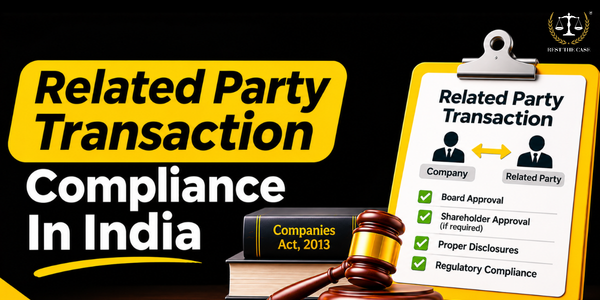
In certain situations, Board approval alone is not sufficient. If a related party transaction crosses the financial limits prescribed under Rule 15 of the Companies (Meetings of Board and its Powers) Rules, 2014, the company must obtain prior shareholder approval through an ordinary resolution.
- Interested Directors Cannot Participate
If a director has an interest in the proposed transaction, they must not participate in the relevant Board discussion or voting, as required under Rule 15(2).
- Restrictions on Shareholder Voting
Under the second proviso to Section 188(1), related party shareholders are generally restricted from voting on resolutions approving the relevant transaction.
What Are the Shareholder Approval Thresholds for Related Party Transactions?
If a transaction is not in the ordinary course of business or is not conducted on an arm's length basis, the company must check the financial limits under Rule 15(3) of the Companies (Meetings of Board and its Powers) Rules, 2014.
Transaction Category | Shareholder Approval Threshold |
|---|---|
Sale, purchase or supply of goods or materials | 10% or more of company turnover |
Sale, purchase or disposal of property | 10% or more of company net worth |
Leasing of property | 10% or more of company turnover |
Availing or rendering services | 10% or more of company turnover |
Appointment to an office or place of profit | Monthly remuneration exceeding ₹2.5 lakh |
Underwriting securities or derivatives | Remuneration exceeding 1% of company net worth |
How Should Companies Calculate These Limits?
Companies must consider a few important points while calculating the financial thresholds.
- Use the Previous Financial Year's Audited Statements
The turnover and net worth figures must be taken from the audited financial statements of the immediately preceding financial year.
- Consider the Combined Transaction Value
A company cannot divide a large transaction into smaller invoices to avoid shareholder approval. The value of the proposed transaction must be considered individually or together with previous transactions during the same financial year.
- Special Relief for Wholly Owned Subsidiaries
Under the fifth proviso to Section 188(1), shareholder approval is not required for transactions between a holding company and its wholly owned subsidiary if the subsidiary's accounts are consolidated with the holding company's accounts and placed before shareholders at the general meeting for approval.
What Is the Difference Between Ordinary Course of Business and Arm's Length Transactions?
The ordinary course of business and arm's length conditions are important because they determine whether a transaction can receive the Section 188(1) approval exemption.
1. Ordinary Course of Business
A transaction is generally considered to be in the ordinary course of business when it forms part of the company's regular business activities and usual commercial operations. While checking this condition, companies may consider:
- Whether the activity is covered under the Objects Clause of the Memorandum of Association (MoA).
- Whether the company regularly enters into similar transactions.
- Whether the transaction is consistent with its previous business activities.
- Whether the arrangement is common in the relevant industry.
2. Arm's Length Transaction
An arm's length transaction means a deal between related parties that is conducted as if both parties were independent and had no special relationship.
- Comparative Quotations: Obtain two or three quotations from independent vendors offering similar goods or services.
- Pricing Records: Maintain market price lists, standard rate cards, or relevant industry benchmarks.
- Valuation Reports: Obtain reports from registered valuers when dealing with property or specialised assets.
- Commercial Agreements: Keep copies of contracts showing payment terms, delivery conditions, and other important clauses.
Simply mentioning that a transaction is commercially reasonable in a Board resolution is not enough. Companies should maintain supporting documents to prove that the deal is fair.
What Disclosures and Registers Must a Company Maintain for Related Party Transactions?
Proper documentation is an important part of related party transaction compliance. Under Sections 184, 189, and 134 of the Companies Act, 2013, companies must maintain certain forms, registers, and records.
- Form MBP-1: Disclosure of Interest by Directors
Under Section 184(1), every director must disclose their interest or concern in other companies, firms, and associations of individuals. This disclosure is generally made at:
- The first Board Meeting attended by the director after appointment.
- The first Board Meeting of every financial year.
- Any subsequent Board Meeting after a change in the earlier disclosure.
Form MBP-1 helps the company identify possible conflicts of interest before approving business arrangements.
- Form MBP-4: Register of Contracts and Arrangements
Under Section 189 and Rule 16, companies must maintain a register of contracts and arrangements covered under Sections 184(2) and 188. This register is maintained in Form MBP-4.
- Form AOC-2: Disclosure in the Board's Report
Under Section 134(3)(h) and Rule 8(2) of the Companies (Accounts) Rules, 2014, companies must disclose applicable related party contracts in Form AOC-2. This includes:
- Contracts that are not conducted on an arm's length basis.
- Material contracts conducted on an arm's length basis.
The form helps shareholders understand the nature of the company's dealings with related parties.
- Board and Audit Committee Meeting Minutes
Companies should maintain detailed minutes of meetings where related party transactions are discussed and approved. These records should include:
- Nature of the transaction.
- Relationship between the parties.
- Pricing details and commercial justification.
- Approval granted by the committee or Board.
- Details of interested directors who did not participate.
- Shareholder Resolutions and Explanatory Statements
Whenever shareholder approval is required, the company must issue a notice for the general meeting. The explanatory statement under Section 102, read with Rule 15(3), should provide relevant information, including the related party's name, nature of relationship, transaction value, and business purpose.
What Is Omnibus Approval for Related Party Transactions?
Some companies enter into related party transactions regularly. To avoid this problem, Section 177(4)(iv) and Rule 6A of the Companies (Meetings of Board and its Powers) Rules, 2014, allow eligible Audit Committees to grant omnibus approval.
- Name of the related party.
- Nature and duration of the transaction.
- Maximum permitted transaction value.
- Indicative base price or current contracted price.
- Method for calculating any price changes.
- Other conditions considered necessary by the Audit Committee.
Important Conditions for Omnibus Approval
Companies must follow certain restrictions while using omnibus approvals.
- Validity Period: An omnibus approval cannot remain valid for more than one financial year. Fresh approval is required after the expiry of this period.
- Periodic Review: The Audit Committee must review the transactions carried out under omnibus approval at least once every quarter, as required under the applicable rules.
- Limited Use: Omnibus approval is meant for regular and predictable transactions. It cannot be used for selling or disposing of the company's undertaking.
What Happens If a Company Violates Related Party Transaction Rules?
Sections 188(3), 188(4), and 188(5) of the Companies Act, 2013, provide consequences for certain violations.
- Three-Month Ratification Period: If a director or employee enters into a related party transaction without obtaining the required prior approval, the company may get an opportunity to ratify it.
- Contract May Become Voidable: If the company does not ratify the transaction within three months, or the required approval is refused, the contract becomes voidable at the option of the Board or shareholders, as applicable under Section 188(3).
- Directors May Have to Compensate the Company: If the transaction involves a related party of a director or was authorised by another director, the concerned directors may have to indemnify the company for losses caused by the transaction.
- Recovery of Losses: Under Section 188(4), the company can take legal action against the director or employee responsible for entering into an unauthorised transaction.
- Monetary Penalties: Section 188(5) prescribes the following penalties for directors or employees who enter into or authorise related party transactions in violation of the applicable provisions:
- Listed company: Penalty of ₹25 lakh.
- Other companies: Penalty of ₹5 lakh.
Apart from these consequences, failure to disclose interests under Section 184 or maintain the required register under Section 189 can attract separate penalties.
How Can a Company Maintain Related Party Transaction Compliance?
- Prepare a Related Party List: Maintain an updated list of directors, KMPs, their relatives, and connected companies under Section 2(76). Listed companies should also consider the broader SEBI definition.
- Collect Form MBP-1: Obtain interest declarations from all directors at the beginning of every financial year and whenever their interests change.
- Check Vendors and Employees: Include related party questions in vendor registration, procurement, and employee hiring procedures.
- Verify Section 188 Applicability: Check whether the proposed arrangement falls under any of the seven categories mentioned in Section 188(1).
- Check Both Exemption Conditions: Independently verify whether the transaction is in the ordinary course of business and on an arm's length basis.
- Maintain Supporting Evidence: Keep independent quotations, market price comparisons, valuation reports, and commercial agreements.
- Calculate Financial Thresholds: Compare the transaction value with the preceding financial year's audited turnover or net worth to determine whether shareholder approval is necessary.
- Obtain Prior Approvals: Secure Audit Committee, Board, and shareholder approvals wherever applicable before entering into the contract.
- Update Form MBP-4: Record the relevant transactions in the statutory register and complete the required authentication and signing formalities.
10. Complete Annual Disclosures: Include applicable information in Form AOC-2 and the related party disclosures in the audited financial statements under AS 18 or Ind AS 24, as applicable.
Recommended Reading
- What Compliance Benefits Does A Small Company Get Under Indian Company Law?
- What Records Must A Company Maintain Under Indian Company Law?
- What Happens During An MCA Inspection? Process, Documents and Company Responsibilities
- Shareholder Rights & Disputes: Complete Guide For Private Companies
- Can MCA Initiate Action Against Company Directors? Grounds, Penalties and Legal Consequences
Conclusion
Related party transaction compliance helps companies maintain transparency and avoid conflicts of interest. The Companies Act, 2013, provides clear rules for identifying related parties, obtaining approvals, maintaining records, and making disclosures. By following these requirements and keeping proper documents, companies can conduct business with connected parties while protecting their interests and avoiding penalties.
Disclaimer: This blog is for informational purposes only. If you require legal consultation, kindly contact an experienced Corporate Lawyer.
Frequently Asked Questions
Q1. What qualifies as a related party transaction in India?
Section 2(76) defines related parties, while Section 188(1) covers seven specific categories, including the purchase of goods, leasing property, providing services, and appointing a related party to an office or place of profit.
Q2. Is Board approval mandatory for every related party transaction?
No. Under Section 188(1), prior Board approval is not required when a transaction is conducted in the ordinary course of business and on an arm's length basis.
Q3. Are related party transactions prohibited under the Companies Act?
No. Related party transactions are legally permitted in India. The Companies Act, 2013, regulates these arrangements through approval procedures, disclosures, and documentation requirements to prevent conflicts of interest and protect shareholders.
Q4. When is shareholder approval required for a related party transaction?
Shareholder approval through an ordinary resolution is generally required when a transaction covered under Section 188(1) is not in the ordinary course of business or is not conducted on an arm's length basis and reaches the financial thresholds prescribed under Rule 15(3).
Q5. Are transactions between holding and subsidiary companies exempt?
Under Section 188(1), shareholder approval is not required if the subsidiary's accounts are consolidated with the holding company's accounts and placed before shareholders for approval at the general meeting.

 Get Expert Advice and Solutions
Experienced lawyers for all legal matters wether it is for Family, Property, Criminal Cases, and More
Consult Now