


Business & Compliance
How Can Businesses Ensure TDS Compliance in India? Rules, Rates, Returns & Penalties

1.1. Common Business Payments Subject to TDS
1.2. Nature of Payment Over Blanket Rates
2. How Can Businesses Check Whether TDS Applies to a Payment? 3. What Information Should You Check Before Deducting TDS? 4. How Should Businesses Deposit TDS and Maintain Records?4.1. Statutory Timelines for Deposit
4.2. Step-by-Step Payment Process
5. How Does TDS Return Filing Work? 6. What Are the Different TDS Returns Businesses May Need to File? 7. When and How Should Businesses Issue TDS Certificates?7.1. Key TDS Certificates and Issuance Timelines
7.2. Best Practices for Issuing Certificates
8. What Are the Most Common TDS Compliance Mistakes? 9. What Happens If a Business Misses TDS Compliance? 10. TDS Compliance & Return Filing Checklist 11. How Can Businesses Create a Simple TDS Compliance Process? 12. ConclusionBusinesses responsible for deducting Tax Deducted at Source (TDS) must identify applicable payments, deduct tax at the correct rate, deposit it within the required timeline, file the relevant TDS returns, and issue applicable TDS certificates. Missing any step can lead to interest, penalties, and other compliance issues.
What Is TDS and When Does a Business Need to Deduct It?
Tax Deducted at Source (TDS) is a mechanism introduced under the Income Tax Act, 1961 to collect income tax directly at the point where income is generated. Instead of waiting for a payee (vendor, landlord, professional, or employee) to calculate and pay tax at the end of the financial year, the law mandates the payer (the business) to deduct a specific percentage of tax before transferring the net amount. The primary objective of TDS is twofold: it provides a continuous, steady flow of revenue to the government while minimizing tax evasion by creating a traceable paper trail for major transactions.
Common Business Payments Subject to TDS
Not every invoice entering your accounts payable workflow requires tax deduction. However, most routine operational expenses trigger TDS provisions once they cross specified financial limits within a financial year.
Key areas include:
- Salaries (Section 192): Deducted based on the individual's applicable income tax slab rates after considering declared investments, regime choices, and deductions.
- Contractor Payments (Section 194C): Payments made to contractors or sub-contractors for work, including advertising, broadcasting, catering, and manufacturing custom goods using customer-supplied materials.
- Professional and Technical Fees (Section 194J): Fees paid for legal, medical, accounting, engineering, consulting, architectural, or technical services.
- Rent (Sections 194I and 194IB): Rent paid for land, buildings, office premises, machinery, plant, or equipment.
Nature of Payment Over Blanket Rates
A frequent mistake in business accounting is applying a single uniform TDS rate across all vendor bills. Because different statutory sections govern distinct types of services, treating a software consultant's invoice as a general contractor payment can cause an under-deduction of tax.
Also Read: Step-by-Step Process For Filing TDS Returns Online in India
How Can Businesses Check Whether TDS Applies to a Payment?
Step 1: Identify the Type of Payment
Categorize the expenditure accurately. Determine whether the transaction represents a contract for work, a professional service, rent for property, an interest payment, or a purchase of goods.
Step 2: Identify the Recipient/Payee
Determine the legal status and tax residency of the deductee. Is the payee a resident individual, a sole proprietorship, a Partnership Firm, an LLP, or a Domestic Company? The entity type often dictates both the applicable threshold limit and the exact percentage of tax to be withheld.
Step 3: Check Whether the Applicable Threshold Is Crossed
Review statutory thresholds under the Income Tax Act. TDS provisions apply either when a single invoice exceeds a specified amount or when cumulative payments to the payee within the financial year cross the prescribed aggregate limit.
Step 4: Check the Applicable TDS Provision and Rate
Cross-reference the payment category and payee profile against the corresponding section of the Income Tax Act to locate the exact applicable rate. Check whether the vendor has submitted a valid certificate for lower or nil deduction issued by the Tax Department under Section 197.
Step 5: Deduct and Record TDS Correctly
Calculate the exact tax amount, deduct it at the time of crediting the payee's account or making the actual payment (whichever occurs earlier), and post the appropriate accounting entries in your general ledger.
What Information Should You Check Before Deducting TDS?
- PAN of the Deductee: Ensure you have an active, validated Permanent Account Number. If the deductee fails to provide a valid PAN (or if the provided PAN is inoperative), higher withholding tax provisions automatically trigger under Section 206AA.
- Nature of Payment: Confirm that the description matches the commercial reality of the service or supply contract.
- Applicable TDS Section: Match the expense item to its correct provision (e.g., Section 194C vs. Section 194J).
- Applicable Rate: Verify current prescribed rates, including higher withholding provisions for non-filers of tax returns under Section 206AB where applicable.
- Payment Amount: Verify basic invoice values and ensure you do not deduct TDS on the GST component, provided the GST amount is itemized separately on the tax invoice (as per CBDT circulars).
- Threshold Limits: Track cumulative year-to-date ledger balances for the specific vendor to ensure timely tax withholding once thresholds are met.
How Should Businesses Deposit TDS and Maintain Records?
Statutory Timelines for Deposit
In general, TDS deducted during any given calendar month must be deposited to the government treasury on or before the 7th day of the following month.
Step-by-Step Payment Process
- Calculate Deducted Taxes: Aggregate all tax amounts withheld across all operational ledgers for the preceding month.
- Generate Electronic Challan: Log in to the official Income Tax e-Filing portal to create and pay through the designated tax payment gateway using Challan ITNS 281.
- Specify Categories: Tag payments accurately under the relevant Head of Account, typically tagged as Company Deductees (200) or Non-Company Deductees (201) under Regular Assessment / Self-Assessment codes.
- Save Payment Proofs: Download and store the electronic payment receipt containing the BSR Code, Challan Serial Number (CSN), Challan Identification Number (CIN), and the exact payment date.
- Reconcile General Ledger: Immediately link the generated CIN against the corresponding ledger entries in your accounting software to ensure every single entry has a clear payment reference.
How Does TDS Return Filing Work?
- Collect Transaction Details: Extract all ledger accounts involving TDS deductions for the relevant quarter.
- Verify PAN Details: Run bulk PAN verification checks to avoid invalid PAN rejections during return processing.
- Reconcile Deductions with Deposits: Match the total tax deducted in your books against the total tax remitted via Challan ITNS 281 receipts.
- Prepare the TDS Statement: Compile the data using the official e-TDS return preparation utility (RPU) or certified accounting software.
- Run Error Diagnostics: Process the data through the File Validation Utility (FVU) provided by NSDL/Tax Department to detect structural formatting errors, missing fields, or mathematical discrepancies.
- Upload to Portal: Submit the validated file (output) electronically on the Income Tax e-Filing portal using your business's valid Digital Signature Certificate (DSC) or Electronic Verification Code (EVC).
- Store Acknowledgement: Securely archive the generated Form 27A and the electronic filing token acknowledgement number for future compliance checks and audits.
What Are the Different TDS Returns Businesses May Need to File?
- Form 24Q (Salary TDS): Used to report tax deducted from employee salaries under Section 192. It includes detailed quarterly line items and an additional comprehensive annual breakdown (Annexure II) submitted in the final quarter detailing employee allowances, deductions, and tax calculations.
- Form 26Q (Non-Salary Domestic TDS): Covers all non-salary payments made to resident Indian individuals and entities. This includes contractor payments, professional fees, rent, interest, commission, and purchase of goods.
- Form 27Q (Non-Resident Payments): Covers tax withholding on payments made to non-resident individuals, foreign entities, or foreign companies (excluding salaries). This form requires careful attention to Double Taxation Avoidance Agreements (DTAA) and higher documentation standards.
- Form 26EQ (Tax Collected at Source - TCS): Used to report Tax Collected at Source (TCS) on specific sales transactions (such as sale of scrap, specified motor vehicles, foreign remittance under LRS, or sale of goods under Section 206C).
When and How Should Businesses Issue TDS Certificates?
If any link in this chain breaks, your vendor's tax ledger will reflect a tax credit mismatch in their Form 26AS / Annual Information Statement (AIS), leading to billing disputes and vendor friction.
Key TDS Certificates and Issuance Timelines
- Form 16 (Salary Certificate): Issued annually to employees (by June 15 following the end of the financial year). It provides a complete breakdown of wages paid, perquisites, tax-exempt allowances, personal deductions, and net tax remitted.
- Form 16A (Non-Salary Certificate): Issued quarterly to vendors, service providers, and contractors (within 15 days from the due date for filing the quarterly TDS return).
Best Practices for Issuing Certificates
- Source Directly from TRACES: Always download official, watermarked TDS certificates directly from the government's TRACES portal.
tdscpc.gov.in). Self-generated certificates created on private company letterheads are not recognized for claiming formal tax credits. - Verify System Reconciliation: Ensure the figures on the generated Form 16A match the invoices billed by the vendor before distributing them.
What Are the Most Common TDS Compliance Mistakes?
- Failing to Recognize TDS Applicability: Assuming small vendor invoices do not attract TDS without monitoring annual aggregate account balances.
- Applying Incorrect Sections or Rates: Booking professional or consulting services under contractor provisions (Section 194C at 1% or 2%) instead of technical/professional services (Section 194J at 10% or 2%), leading to short-deduction demands.
- Missing Inoperative or Unfurnished PANs: Failing to verify whether a vendor's PAN is linked with Aadhaar or actively operative, resulting in a failure to apply the mandatory 20% flat withholding rate under Section 206AA.
- Delaying Deductions: Deducting tax when the vendor's invoice is actually paid weeks or months later, rather than when the invoice was credited to the general ledger (or vice versa).
- Late Tax Deposits: Deducting tax on time but missing the 7th-of-the-month remittance deadline due to manual treasury processing delays.
- Ignoring System Notices: Treating automated default notices or demand communications on the TRACES portal as low-priority operational items.
What Happens If a Business Misses TDS Compliance?
- Interest Charges for Default
- Delayed Deduction: If you fail to deduct TDS when required, interest accrues at 1% per month (or part of a month) from the date tax was deductible to the date it is actually deducted.
- Delayed Deposit: If you deduct tax but fail to remit it to the government treasury on time, interest accrues at 1.5% per month (or part of a month) from the date of deduction to the date of actual deposit.
- Late Filing Fees
If a business files its quarterly TDS return past the statutory due date, a mandatory late fee of ₹200 per day applies under Section 234E for every day the default continues. This fee accumulates continuously until the return is submitted, capped at the total amount of TDS deductible for that quarter.
- Penalties for Non-Filing or Incorrect Filing
Over and above late filing fees, tax officers can impose discretionary penalties under Section 271H (ranging from ₹10,000 up to ₹1,000,000) for failing to file quarterly returns within prescribed extended limits or for submitting willfully incorrect return details.
- Expense Disallowance (Section 40(a)(ia))
This is often the most damaging financial consequence for a business. Under Section 40(a)(ia) of the Income Tax Act, if a business fails to deduct TDS or fails to deposit deducted taxes on or before the due date for filing its annual Income Tax Return, 30% of the underlying expenditure is disallowed as a deductible business expense for that financial year.
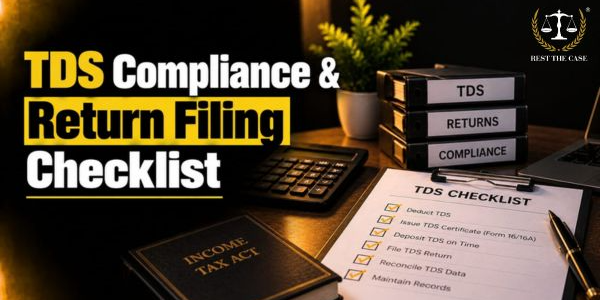
TDS Compliance & Return Filing Checklist
Compliance Area | What to Check |
|---|---|
Payment Identification | Pinpoint the precise commercial nature of every expense, purchase order, or agreement. |
Applicability | Cross-reference expense items against Income Tax Act provisions to confirm if TDS applies. |
PAN Verification | Collect, validate, and check the status (active/operative) of the deductee’s PAN. |
Rate Selection | Verify current statutory withholding rates, checking for Section 206AA or Section 206AB triggers. |
Threshold Tracking | Monitor cumulative fiscal year balances to catch transactions crossing single or aggregate limits. |
Timely Deduction | Ensure TDS is deducted at the time of credit to the ledger or payment, whichever is earlier. |
Deposit Execution | Remit withheld taxes using Challan ITNS 281 by the 7th of the following month (April 30 for March). |
Record Archiving | Retain payment challans, CIN references, BSR codes, and vendor tax invoices securely. |
Internal Reconciliation | Periodically match general ledger TDS accounts against e-Filing portal payment records. |
Return Submission | Upload validated Forms 24Q, 26Q, or 27Q quarterly within statutory deadline windows. |
Certificate Issuance | Download official Form 16/16A from TRACES and issue to deductees within prescribed timelines. |
Notice Management | Review the TRACES portal regularly to clear minor processing errors, mismatches, or system demands. |
How Can Businesses Create a Simple TDS Compliance Process?
- Before Payment (Pre-Transaction Stage)
- Require vendors to provide a copy of their PAN card and tax residency declarations during onboarding.
- Tag vendor master profiles in your accounting software with their designated TDS section (e.g., 194C, 194J, 194I) to automate deduction suggestions.
- Enforce a rule requiring accounts payable personnel to verify TDS applicability before approving vendor bills.
- During Payment (Execution Stage)
- Ensure software configurations automatically deduct TDS when booking invoices or executing advances.
- Exclude itemized GST components from the TDS calculation base.
- Provide vendors with payment advice notes clearly showing gross invoice values, deducted TDS, and net payouts.
- After Payment (Post-Transaction Stage)
- Schedule automated monthly reminders for the 3rd or 4th of every month to consolidate deducted taxes and execute Challan ITNS 281 deposits well before the 7th deadline.
- Attach tax payment receipts directly to monthly accounting closing files.
- Periodically (Quarterly Review & Reconciliation)
- Reconcile TDS payable accounts in your general ledger against total challan deposits before generating the final file.
- File quarterly returns early in the filing window to leave enough buffer time to resolve potential PAN or challan validation errors.
- Download official Form 16A certificates in bulk from TRACES and email them promptly to payees.
Conclusion
TDS compliance is an important part of managing business finances in India. Businesses should identify applicable payments, verify PAN details, apply the correct rates, track thresholds, deduct and deposit tax on time, and file quarterly returns accurately. Maintaining proper records and reconciling accounts regularly can help prevent mismatches, interest, late fees, penalties, and expense disallowances.
Disclaimer: This blog is for informational purposes only. If you require legal consultation, kindly contact an experienced Corporate Lawyer.
Frequently Asked Questions
Q1. What is TDS compliance for businesses?
TDS compliance refers to a business's legal obligation to withhold tax from specified payments (such as vendor bills, salaries, rent, and professional fees), remit those funds to the government within set timelines, file quarterly TDS statements, and issue tax certificates to payees.
Q2. When is a business required to deduct TDS?
A business must deduct TDS whenever it makes a payment covered under specific sections of the Income Tax Act that exceeds the applicable statutory threshold. The deduction must occur at the time of crediting the payee's account in the books or making the actual payment, whichever happens first.
Q3. How do I know which TDS rate applies?
The applicable TDS rate depends on the nature of the expense (e.g., contractor work vs. professional service), the payee's legal status (individual, firm, or company), and whether a valid, operative PAN is provided. These rates are detailed in specific sections of the Income Tax Act.
Q4. What happens if TDS is deducted late?
If a business delays deducting TDS when it was legally required to do so, mandatory interest accrues at 1% per month (or part of a month) from the date tax was deductible up to the date it is actually deducted.
Q5. What happens if a business deposits TDS late?
If tax is deducted on time but remitted past the statutory monthly due date (the 7th of the following month), interest accrues at 1.5% per month (or part of a month) from the exact date of deduction to the date of deposit.

 Get Expert Advice and Solutions
Experienced lawyers for all legal matters wether it is for Family, Property, Criminal Cases, and More
Consult Now