


Know The Law
What Is Illegal Construction As Per Housing Society Rules?

2.1. Structural Changes Without Approval
2.2. Unauthorized Balcony Extensions
2.3. Covering Or Encroaching On Common Areas
2.4. Additional Rooms Or Floors
2.5. Common Examples of Illegal Construction
3. Can A Flat Owner Renovate Without Society Permission?3.1. Renovation vs. Illegal Construction
3.2. Is Society Approval Alone Sufficient?
4. Legal Framework Governing Housing Societies 5. What Action Can A Housing Society Take Against Illegal Construction? 6. Can Municipal Authorities Demolish Unauthorized Construction? 7. Rights of Neighboring Residents 8. Authority and Role Matrix 9. Critical Legal Realities of Unauthorized Construction9.1. Can Illegal Construction Be Regularized?
9.2. Impact On Property Transactions
10. ConclusionIn a housing society, illegal construction simply means making structural changes, alterations, or extensions to your flat without official permission. To do any major remodeling, you legally need two green lights: written consent from your society's managing committee and formal approval from the local municipal corporation. Even though you bought the apartment, you cannot tamper with the building’s original sanctioned plan.
Common examples include enclosing an open balcony, building an extra loft, breaking down internal load-bearing walls, or extending your safety grill into the common corridor. These unauthorized changes violate society’s bylaws and can compromise the entire building's structural safety. If you are caught, the committee can penalize you, issue a legal notice, or call municipal authorities to demolish the structure at your own expense.
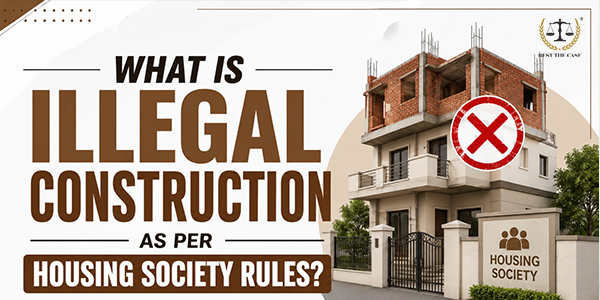
What Is Illegal Construction As Per Housing Society Rules?
In the context of a cooperative housing society or apartment association, illegal construction refers to any structural alteration, extension, modification, or addition made to a housing unit or common area that violates the registered society bye-laws, local building bye-laws, or the master sanctioned plan approved by the municipal planning authority. A housing society operates under a strict legal framework. When a developer builds a residential complex, they must strictly follow a building plan sanctioned by the local municipal corporation or development authority. This plan specifies the precise floor space index (FSI), structural loads, open spaces, balcony sizes, and common utility areas.
Any construction activity that alters this approved footprint without explicit, written permission from both the housing society’s Managing Committee and the local municipal authority is legally unauthorized. Within a society, illegal construction is not limited to erecting new brick-and-mortar rooms; it includes internal modifications that threaten structural stability or encroach upon space intended for public or common use.
What Activities Are Generally Considered Illegal Construction?
Unauthorized modifications take many forms. While some flat owners intentionally maximize space at the expense of building regulations, others commit violations due to a lack of awareness regarding local building codes.
Structural Changes Without Approval
The most critical violations involve the core structural skeleton of the building, specifically columns, beams, girders, and load-bearing walls. These elements are mathematically engineered to distribute the dead weight and live weight of the entire building down to its foundation.
- The Hazard: Breaking down an internal wall to create a modern "open kitchen" concept or merging two rooms might seem like a cosmetic choice. However, if that wall is load-bearing, its removal shifts critical stress to adjacent walls and floors.
- The Violation: Modifying, drilling deep into, or cutting any load-bearing structural component without a structural engineer’s structural stability certificate and municipal approval is entirely illegal.
Unauthorized Balcony Extensions
Balconies are designed as open or semi-open projections with specific cantilever load capacities. They are typically excluded from or treated differently in FSI calculations by municipal authorities.
- The Hazard: Brick mortar, heavy window frames, and glass installations add unexpected weight to the cantilever slab.
- The Violation: Enclosing an open balcony with brick masonry, sliding glass panels, or grilles to convert it into an extra bedroom or extended living area without municipal planning approval is a severe building bye-law violation.
Covering Or Encroaching On Common Areas
Common areas belong collectively to all members of the society through undivided land share ownership. No individual member can claim exclusive domain over them.
- Examples: Installing a private gate in a common corridor, blocking emergency stairwells with shoe racks or storage units, enclosing the dead space below staircases, or putting up a private lock on the common terrace door.
- The Violation: Converting shared structural property into private property is an illegal encroachment under property law and society bye-laws.
Additional Rooms Or Floors
This form of unauthorized construction is frequently observed in ground-floor apartments with attached open margins or top-floor penthouses with access to the roof.
- Examples: Erecting temporary or permanent brick walls, tin sheds, or gypsum board partitions in open backyards, building a room on a private terrace, or constructing a mezzanine floor inside a flat with high ceilings.
- The Violation: Any addition that expands the built-up area beyond the original sanctioned configuration is highly illegal and subject to immediate municipal action.
Common Examples of Illegal Construction
Example | May Be Unauthorized | Reason |
|---|---|---|
Covering the common corridor | Yes | It takes over shared society space and can block emergency fire exits. |
Extending a balcony beyond approved limits | Yes | It breaks municipal FSI rules and may put extra load on the building. |
Building an extra floor or mezzanine | Yes | It is an illegal expansion and goes beyond the approved building limits. |
Breaking structural walls or columns | Yes | It can weaken the building and may violate state apartment laws. |
Using the terrace without permission | Yes | The terrace is a common area shared by all society members, so using it without approval is not allowed. |
Can A Flat Owner Renovate Without Society Permission?
When fixing up your flat, there is a legal difference between a basic renovation and a structural alteration. A simple renovation keeps everything within the same footprint, like painting or changing cabinets. Structural alterations actually change the building's core framework, like breaking down walls. While you can safely handle minor aesthetic internal repairs without heavy municipal sanctions, you still cannot just start your construction work right away. Under housing society bye-laws, prior written intimation or official permission from your housing society management committee is absolutely mandatory to ensure you do not disturb your neighbors or cause severe property damage.
Renovation vs. Illegal Construction
Allowed Renovation (Inform the Society) | Illegal Construction (Not Allowed / Needs Municipal Approval) |
|---|---|
Plastering and painting inside walls | Removing or changing load-bearing walls, beams, or pillars |
Replacing floor tiles or bathroom fittings | Building extra rooms, lofts, or mezzanine floors |
Internal woodwork, modular kitchens, and furniture changes | Taking over or closing common corridors, lift areas, or terraces |
Minor plumbing repairs and electrical rewiring | Extending balconies without approval or shifting wet areas over dry areas |
Even for basic renovations, a society's bye-laws typically require the member to submit an application stating the scope of work, paying a security deposit, adhering to designated working hours, and ensuring debris is safely disposed of without damaging common elevators or lobbies.
Is Society Approval Alone Sufficient?
A major point of confusion for property owners is whether a "No Objection Certificate" (NOC) from the housing society's Managing Committee completely sanitizes a construction activity.
Crucial Legal Principle: A housing society's permission cannot override municipal law.
The Managing Committee of a cooperative housing society does not possess legislative or planning authority. It cannot legalize an activity that is fundamentally prohibited by local building bye-laws or municipal corporations.
For example, if you obtain written permission from your housing society's committee to enclose your balcony or build a shed in your backyard, that construction remains illegal under municipal law if it has not been officially sanctioned by the local municipal corporation's planning department. If a municipal officer issues a demolition notice under local town planning laws, the society’s NOC offers zero legal protection against the demolition of the structure.
Legal Framework Governing Housing Societies
The control of unauthorized construction relies on layered legal systems spanning national property laws, state legislation, and local municipal regulations.
- Transfer of Property Act, 1882
While Section 5 defines the basic transfer of immovable property, the underlying principles of the Act dictate that a buyer cannot exercise ownership rights in a manner that degrades or destroys the structural integrity of a shared estate or violates the covenants under which the property is held.
- Registration Act, 1908
Under Section 17, documents relating to the transfer, lease, or assignment of immovable property must be compulsorily registered. The registered sale deed maps out the exact boundaries and square footage of the flat. Any unauthorized expansion or modification deviates from this registered document, creating discrepancies in title clearance during subsequent sales or property financing.
- State Co-operative Societies Act & Apartment Ownership Laws
Every housing society is governed by state-specific statutes, such as the Maharashtra Co-operative Societies Act, 1960, the Karnataka Co-operative Societies Act, 1959, or corresponding State Apartment Ownership Acts.
- These statutes empower societies to frame Model Bye-Laws.
- The bye-laws constitute a legally binding contract between the society and its members.
- They explicitly state that members cannot carry out additions, alterations, or structural changes within their flats without written permission from the Managing Committee and the local planning body.
- Municipal Laws & Building Bye-Laws
Local planning bodies, such as the Municipal Corporation of Greater Mumbai (MCGM/BMC), Delhi Development Authority (DDA), or Bruhat Bengaluru Mahanagara Palike (BBMP), possess statutory powers derived from State Municipal Corporation Acts. These rules dictate that any construction or modification must align with development control regulations. Executing changes without an approved building plan is a statutory offense.
What Action Can A Housing Society Take Against Illegal Construction?
When a member engages in unauthorized modification or encroaches on shared property, the housing society’s Managing Committee has a fiduciary duty to protect the structural integrity and shared assets of the complex. The society can initiate the following progressive actions:
- Issue A Notice
Upon discovering unauthorized construction, the Managing Committee should issue a formal, written Show-Cause Notice to the defaulting member. The notice must specify the exact violation of the society’s bye-laws, detail the structural risk or encroachment, and grant the member a specific timeframe (usually 7 to 15 days) to submit an explanation.
- Ask For Restoration
If the member fails to provide a satisfactory reply, the society must issue a final Restoration Notice. This order directs the member to stop the construction work immediately and dismantle the unauthorized additions or restore the altered structural walls to their original condition at their own expense. If the member ignores this, the society can levy monetary penalties as permitted under its registered bye-laws.
- Report To Municipal Authorities
If the member remains non-compliant, the society should submit a formal written complaint to the local municipal corporation (e.g., the Ward Officer or Building Proposals Department). The complaint should include photographs of the illegal structure, references to the violated bye-laws, and copies of the unheeded notices issued by the society.
- Initiate Legal Proceedings Where Appropriate
If the unauthorized construction poses an immediate hazard to the building’s structural stability, the society can approach a competent legal forum. Depending on state laws, they can file a dispute before the Co-operative Court or move a civil court for a Permanent Injunction to restrain the member from executing further modifications.
Can Municipal Authorities Demolish Unauthorized Construction?
Yes, municipal corporations possess sweeping statutory powers to deal with building violations. Once a housing society or an affected neighbor logs an official complaint, the municipal corporation follows a strict statutory procedure:
- Inspection: A municipal surveyor visits the premises to inspect the construction and verify it against the original sanctioned plan stored in the corporation's archives.
- Statutory Notice: If a deviation is found, the authority issues a legal notice under the relevant state municipal act (e.g., Section 351 of the Mumbai Municipal Corporation Act or Section 317 of the Bruhat Bengaluru Mahanagara Palike Act). The notice demands that the owner show cause why the unauthorized structure should not be removed or altered.
- Demolition Order: If the owner cannot produce an authorized, sanctioned plan regularizing the construction within the notice period, the municipal commissioner or designated officer issues a definitive demolition order.
- Enforcement: If the owner refuses to dismantle the modification, the municipal demolition squad, backed by local law enforcement, will forcibly demolish the illegal structure. The entire cost of the demolition drive is recovered from the defaulting flat owner as arrears of land revenue.
Rights of Neighboring Residents
Often, a housing society’s Managing Committee may choose to ignore violations due to internal politics or personal relationships with the defaulting member. In such situations, neighboring residents who are directly or indirectly affected by the illegal construction are not helpless.
An individual resident whose light, ventilation, structural safety, or right to unhindered passage through common areas is compromised has the independent right to act:
- Direct Complaint: The affected resident can bypass the Managing Committee and file a direct, written complaint with the local municipal corporation.
- Right to Information (RTI): The resident can file an RTI application with the local municipality to fetch copies of the sanctioned building plan for the flat in question, validating the structural variation.
- Civil Remedies: Under common law and the law of torts, the affected neighbor can file a civil suit for Nuisance and Trespass or seek a court mandate for the removal of the encroachment that interferes with their easement rights.
Authority and Role Matrix
Authority | What They Do | Legal Power |
|---|---|---|
Housing Society | Enforces society by-laws, sends notices, charges penalties, and manages day-to-day renovations. | Can take internal action and file cases in Co-operative Courts. It cannot demolish parts of your flat. |
Municipal Corporation | Checks building rules, inspects changes, and issues demolition notices if needed. | Can stop construction, seal properties, and carry out demolitions under the law. |
Planning Authority | Checks approved building plans, FSI use, and regularization requests. | Looks after zoning rules, structural approvals, and building compliance. |
Competent Court | Decides legal disputes, grants temporary or permanent orders, and awards damages. | Can cancel unfair society actions, penalize rule violations, and protect property rights. |
Critical Legal Realities of Unauthorized Construction
A few such legal realities are:
Can Illegal Construction Be Regularized?
In specific circumstances, municipal corporations launch schemes to regularize minor deviations by charging a penalty fee or compounding fee. However, regularization is only possible if the modification falls within the permissible limits of local development control rules, such as available, unused FSI within the overall plot layout. Critical Structural Violations Cannot Be Regularized. Any modification that breaks a load-bearing column, compromises fire safety, or encroaches upon common public margins can never be regularized by paying a fine.
Impact On Property Transactions
Engaging in illegal construction permanently damages the marketability of your property.
- No Bank Financing: When a future buyer applies for a home loan, the bank sends an independent legal counsel and a technical structural engineer to inspect the property. If the technical surveyor discovers that the physical flat layout deviates significantly from the sanctioned layout plan (e.g., an enclosed balcony or an added room), the bank will immediately reject the loan application.
- Defective Title: The property becomes incredibly difficult to sell, as astute buyers will demand a clean structural report and matching dimensions before executing a transfer.
Conclusion
Changing your home can make it more comfortable, but never ignore structural safety, local laws, or your housing society's peace. A flat is not separate; it is part of a shared building. Before breaking walls or expanding, check your state's apartment rules and speak with a certified structural engineer. Get approval from your society's Managing Committee and local municipal authority. This helps you avoid legal cases, demolition, and future property sale problems with proper documentation.
Disclaimer: This blog is for informational purposes only. If you need legal consultation, please contact an experienced civil lawyer.
Frequently Asked Questions
Q1. What is illegal construction as per housing society rules?
It is any modification, room addition, structural alteration, or encroachment on common areas executed within a housing society that violates the registered society bye-laws, state cooperative acts, or the building plan sanctioned by the local municipal corporation.
Q2. Can I renovate my flat without society permission?
No. While you can perform basic internal cosmetic updates (like painting or changing tiles) without an extensive municipal permit, you must formally notify or obtain permission from your housing society to ensure compliance with working hours, debris disposal, and safety codes.
Q3. Is society approval enough for structural changes?
Absolutely not. A housing society's NOC cannot override municipal planning laws. Major structural changes or built-up area expansions require formal approvals and modified layouts sanctioned by the local municipal planning authority and certified by a licensed structural engineer.
Q4. Can a balcony be enclosed without approval?
No. Enclosing an open balcony changes the facade of the building, alters the engineered weight distribution on the cantilever slab, and violates FSI rules. It is categorized as unauthorized construction by municipal authorities.
Q5. Can municipal authorities demolish unauthorized construction?
Yes. Municipal corporations have the explicit statutory power to inspect building deviations, issue legal show-cause notices, and physically demolish unauthorized structures at the flat owner's risk and expense if valid sanctioned plans cannot be produced.

 Get Expert Advice and Solutions
Experienced lawyers for all legal matters wether it is for Family, Property, Criminal Cases, and More
Consult Now