


Business & Compliance
Can the FDA Shut Down A Restaurant In India? Know Your Legal Rights

1.1. When Closure or Sealing Becomes a Legal Consequence
2. What Can FDA Officials Check During a Restaurant Inspection? 3. FDA Restaurant Inspection & Enforcement Framework 4. What Happens If the FDA Finds Violations in a Restaurant? 5. Can the FDA Suspend or Cancel a Restaurant’s FSSAI Licence? 6. Can FDA Officials Take Food Samples From a Restaurant? 7. Can a Restaurant Owner Challenge FDA Action? 8. What Should a Restaurant Owner Do After an FDA Inspection? 9. What Food Safety Rules Must Restaurants Follow in India? 10. What Can Customers Do If a Restaurant Serves Unsafe or Unhygienic Food? 11. ConclusionIn India, state food safety authorities, commonly referred to as the Food and Drug Administration (FDA), hold statutory authority under the Food Safety and Standards Act, 2006 (FSS Act) to inspect, issue improvement notices, suspend or cancel FSSAI licences, and seal or shut down restaurants operating under unhygienic conditions or posing an immediate health hazard. Restaurant owners retain legal rights to receive written notices, present proof of corrective action, and appeal enforcement orders before designated appellate authorities.
Can the FDA Shut Down or Seal a Restaurant?
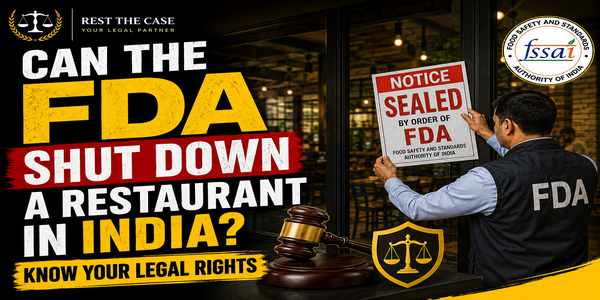
Yes, state FDA authorities (operating as the enforcement arm of the Food Safety and Standards Authority of India - FSSAI) have the legal power to seal or shut down a restaurant in India. However, this power is regulated by statutory provisions under the Food Safety and Standards Act, 2006 and cannot be exercised arbitrarily.
When Closure or Sealing Becomes a Legal Consequence
Under Section 32 and Section 33 of the FSS Act, 2006, a Food Safety Officer (FSO) or Designated Officer (DO) can initiate closure or sealing proceedings under specific circumstances:
- Emergency Prohibition Orders: If the authority determines that operational conditions pose an immediate, grave risk to public health (e.g., severe pest infestation, contaminated water source, or outbreaks of foodborne illness).
- Operating Without a Valid License/Registration: Running a food business without a valid FSSAI licence under Section 31, which carries penalties including imprisonment up to six months and fines up to ₹5 lakh.
- Failure to Comply with Improvement Notices: If a restaurant fails to rectify deficiencies outlined in a formal Improvement Notice (Section 32) within the stipulated timeframe, the Designated Officer can suspend the licence and order the establishment to cease operations.
- Adulteration & Severe Contamination: Discovery of banned substances, dangerous industrial contaminants, or severe adulteration under Section 59.
Also Read: Online FSSAI License Service India
What Can FDA Officials Check During a Restaurant Inspection?
During an inspection, Food Safety Officers evaluate compliance against Schedule 4 hygienic and sanitary practices of the Food Safety and Standards (Licensing and Registration of Food Businesses) Regulations, 2011:
- Food Quality & Safety: Raw material freshness, absence of prohibited food additives, and prevention of cross-contamination between raw and cooked food.
- Kitchen Hygiene & Infrastructure: Cleanliness of food preparation surfaces, proper ventilation, operational grease traps, covered drainage systems, and documented pest control contracts.
- Food Storage: Maintenance of cold chain temperatures (chillers kept below 5°C, freezers below -18°C), clear labeling, and compliance with First-In, First-Out (FIFO) inventory practices.
- Expiry Dates: Verification of raw materials, sauces, canned goods, and pre-packaged ingredients to ensure no expired items are stored on the premises.
- FSSAI Licence & Statutory Records: Prominent display of the FSSAI Licence Certificate and Food Safety Display Board (FSDB), water testing reports from NABL-accredited labs, medical fitness certificates of food handlers, and FoSTaC training records.
- Food Handling Practices: Personal hygiene of staff, including clean aprons, hairnets, disposable gloves, handwashing stations, and exclusion of ill workers from handling food.
FDA Restaurant Inspection & Enforcement Framework

What Happens If the FDA Finds Violations in a Restaurant?
- Inspection Findings & Notice: If violations are observed, the Food Safety Officer records deficiencies in an inspection report. For non-critical defects, the officer issues an Improvement Notice under Section 32, providing a clear timeframe (typically not less than 14 days) for compliance.
- Corrective Action Period: The restaurant owner must implement required changes, such as repairing infrastructure, upgrading pest management, or training staff, and submit a written compliance report accompanied by photo or video evidence.
- Penalties & Legal Adjudication
For specific statutory violations, authorities can initiate monetary penalties under Chapter X of the FSS Act through the Adjudicating Officer (usually an Additional District Magistrate):
- Selling Food Not of the Nature/Quality Demanded (Sec 54): Fine up to ₹5 lakh.
- Substandard Food (Sec 51): Fine up to ₹5 lakh.
- Misbranded Food (Sec 52): Fine up to ₹3 lakh.
- Unhygienic/Unsanitary Processing (Sec 56): Fine up to ₹1 lakh.
Can the FDA Suspend or Cancel a Restaurant’s FSSAI Licence?
When Suspension or Cancellation May Happen
Yes. The Designated Officer can suspend an FSSAI licence under Section 32(3) if the food business operator fails to comply with an Improvement Notice or if operating conditions present an ongoing public health risk. If the business fails to rectify violations during the suspension period, the Designated Officer can formally cancel the licence under Section 32(5) after providing an opportunity to be heard.
Legal Options for the Restaurant Owner
- Right to Show Cause: The authority must provide a written notice stating the grounds for proposed suspension or cancellation, allowing the owner to present a defense.
- Statutory Appeal (Section 70): Any restaurant owner aggrieved by an order of suspension or cancellation can file a formal appeal to the State Commissioner of Food Safety within 15 days of receiving the order.
- Secondary Appeal: If the Commissioner upholds the suspension/cancellation, a second appeal can be filed before the Food Safety Appellate Tribunal within 45 days.
Can FDA Officials Take Food Samples From a Restaurant?
When Samples May Be Taken
Under Section 38 and Section 47 of the FSS Act, 2006, a Food Safety Officer is authorized to take samples of raw ingredients, cooked food, sauces, or water at any time during operational hours for testing and analysis.
Protocol After Sampling
- Form VI Notice: The FSO must serve written notice in Form VI declaring their intention to have the sample analyzed by a Food Analyst.
- Sample Division: The sample must be divided into four equal parts in the presence of the restaurant owner or representative, sealed, and labeled.
- Distribution of Parts:
- Part 1 is sent to the Food Analyst for testing.
- Parts 2 and 3 are deposited with the Designated Officer.
- Part 4 is sent to an accredited referral laboratory if requested by the food business operator.
- Right to Referral Analysis (Section 46): If the initial Food Analyst report declares the sample substandard or adulterated, the restaurant owner has a statutory right to appeal the finding within 14 days and request that the Designated Officer send the reserved sample to a Referral Food Laboratory, whose findings supersede the initial report.
Can a Restaurant Owner Challenge FDA Action?
A restaurant owner cannot be subjected to arbitrary action. Remedies include:
- Submitting a Written Representation: Challenging administrative errors, procedural deviations during sampling, or unreasonable compliance windows.
- Filing Statutory Appeals: Escalating orders to the Commissioner of Food Safety or the Food Safety Appellate Tribunal.
- Writ Petitions before the High Court: If the FDA seals a restaurant without issuing prior notice, violates principles of natural justice (audi alteram partem), or exceeds its statutory authority, the owner can file a Writ Petition under Article 226 of the Constitution of India seeking an emergency stay and re-opening orders.
Also Read: 12 Types of Petitions in Indian Court
What Should a Restaurant Owner Do After an FDA Inspection?
- Obtain and Review the Inspection Report: Carefully read the formal inspection memo or Form of Inspection left by the FSO.
- Address Violations Systematically: Categorize deficiencies into immediate structural repairs, hygiene protocol updates, and documentation updates
- Respond Within Mandatory Timelines: Submit a formal written compliance letter within the specified window (typically 14 days), explicitly detailing how each noted point was resolved.
- Maintain Verified Proof of Corrective Action: Retain invoices for pest control, NABL lab test reports for water, employee medical certificates, and clear before-and-after photograph/video logs as evidence.
- Request Re-Inspection: Formally invite the Designated Officer to conduct a re-inspection to verify compliance and obtain written confirmation clearing the establishment.
What Food Safety Rules Must Restaurants Follow in India?
Basic FSSAI Requirements
- Valid Registration/Licence: Displaying an active FSSAI Registration (for turnover up to ₹12 lakh) or State/Central Licence (for turnover above ₹12 lakh) under Section 31.
- Food Safety Display Board (FSDB): Color-coded display board posted in customer-viewable areas listing safety guidelines and the 14-digit FSSAI licence number.
Hygiene & Food-Handling Protocols (Schedule 4)
- Potable Water Standards: Annual testing of water used for cooking, ice, and dishwashing from an NABL-accredited laboratory confirming compliance with IS 10500 standards.
- FoSTaC Certified Supervisor: Having at least one Food Safety Supervisor trained through the Food Safety Training and Certification (FoSTaC) program present during operational hours.
- Health Checks: Bi-annual medical examinations and vaccination records for all food-handling staff to confirm absence of communicable diseases.
What Can Customers Do If a Restaurant Serves Unsafe or Unhygienic Food?
How to File a Complaint
- National Consumer Helpline (NCH): Register complaints via the UMANG App or call 1915.
- FSSAI National Consumer Portal: Submit complaints through the FSSAI Food Safety Connect Portal or the Food Safety Connect App.
- Local Food Safety Department: File a formal written complaint with the district Designated Officer or Food Safety Commissioner.
Essential Evidence to Preserve
- Original Purchase Bill / Tax Invoice: Valid proof of purchase establishing date, time, and establishment identity.
- Photographic & Video Proof: Clear images of foreign matter, pest infestation, undercooked ingredients, or expired pre-packaged food.
- Medical Records: Doctor's prescriptions, diagnostic reports, and emergency hospital discharge summaries in cases of acute food poisoning.
- Retained Food Sample: Storing the unconsumed, contaminated food item in a sealed container if immediate testing is pursued.
Possible Consumer Remedies
Consumers can approach the District Consumer Disputes Redressal Commission under the Consumer Protection Act, 2019 to claim refunds, medical cost compensation, and damages for mental agony and negligence.
Also Read: Consumer Protection Laws in India
Conclusion
FDA enforcement can range from an inspection report and Improvement Notice to licence suspension, cancellation, or emergency sealing, depending on the seriousness of violations. Restaurant owners should respond within prescribed timelines, maintain evidence of corrective action, and seek re-inspection where appropriate. They also have rights to show cause and pursue statutory appeals against adverse orders. Maintaining FSSAI licensing, hygiene standards, proper records, and food-safety practices is essential to avoid enforcement action.
Disclaimer: This blog is for informational purposes only. If you need legal consultation, please contact an experienced civil lawyer.
Frequently Asked Questions
Q1. Can FDA inspect a restaurant without notice?
Yes. Under Section 38 of the FSS Act, 2006, Food Safety Officers hold statutory authority to enter and inspect any food business premises at any time during operational hours without prior notice.
Q2. Can FDA take action against a restaurant for unhygienic conditions?
Yes. Failure to comply with Schedule 4 hygienic and sanitary standards can result in Improvement Notices, monetary fines up to ₹1 lakh under Section 56, and licence suspension or facility sealing if unaddressed.
Q3. What happens if a restaurant sells expired food?
Selling or storing expired items violates FSSAI regulations. Authorities can seize the expired inventory, issue monetary penalties for selling unsafe or substandard food, and suspend the restaurant's FSSAI licence in severe cases.
Q4. Can a restaurant reopen after FDA action?
Yes. A sealed or suspended restaurant can reopen once all non-compliances are rectified, verified through a re-inspection by the Food Safety Officer, and a formal revocation order is issued by the Designated Officer or Commissioner.
Q5. Where can I complain about an unsafe restaurant?
Complaints can be lodged through the FSSAI Food Safety Connect Portal, the National Consumer Helpline (1915), or directly with the local Designated Officer / Food Safety Commissioner's Office in your district.

 Get Expert Advice and Solutions
Experienced lawyers for all legal matters wether it is for Family, Property, Criminal Cases, and More
Consult Now