


Business & Compliance
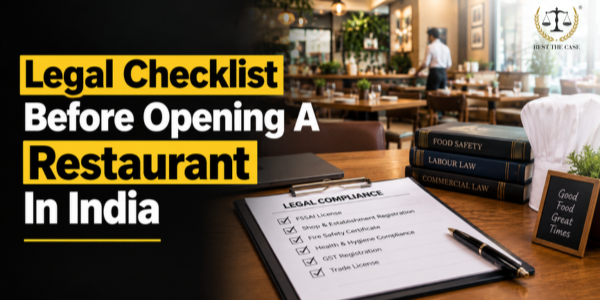
Legal Checklist Before Opening A Restaurant In India

2.1. FSSAI Registration vs. License
2.2. Application, Display, and Compliance Rules
3. Does a New Restaurant Need GST Registration?3.1. GST Registration Thresholds
3.2. Applicable GST Rates and Structure
4. What Local Licences Are Required to Open a Restaurant? 5. Is a Fire NOC Required for a Restaurant?5.1. Thresholds and Requirements
6. What Labour Compliance Is Required for Restaurant Employees?6.1. Key Statutory Requirements
7. What Additional Licenses Does a Restaurant Need? 8. What Documents Should You Keep Ready Before Opening? 9. Restaurant Opening Legal Checklist 10. ConclusionBefore deciding to open a restaurant in India, complete the relevant business registration, FSSAI licensing, GST registration where applicable, local trade permissions, health and hygiene approvals, fire safety clearances, and labour compliances. Additional licenses may be needed based on your restaurant’s location, food products, services, and premises. Since requirements are different across States and cities, businesses should identify applicable local and industry-specific approvals before starting operations to avoid penalties, delays, or closure risks.
What Legal Approvals Do You Need Before Opening a Restaurant?
The legal checklist needed before you start a restaurant includes:
- Business/Entity Registration: Establishing the corporate structure (Proprietorship, LLP, Private Limited Company).
- FSSAI License/Registration: Primary food safety clearance from the Food Safety and Standards Authority of India (FSSAI).
- GST Registration: Compulsory tax registration where turnover thresholds or specific supply conditions are met.
- Local Trade/Health License: Issued by the local municipal body to allow food business operations on different premises.
- Shop & Establishment Registration: Mandatory registration with the state labour department governing working conditions.
- Fire Safety Approval/NOC: Clearance from the local fire department ensuring safety compliance.
- Eating-house/Municipal Permissions: Police or municipal clearance required in select jurisdictions (e.g., Delhi, Mumbai).
- Liquor License: Mandatory state excise approval if serving alcoholic beverages.
- Music/Public-performance Licenses: Approvals from copyright organizations if playing commercial music.
- Signage/Advertising Permissions: Local municipal clearance for external signboards and branding.
Do You Need an FSSAI License to Open a Restaurant?
Yes. Every Food Business Operator (FBO) in India should get clearance from the Food Safety and Standards Authority of India (FSSAI) before commencing operations.
FSSAI Registration vs. License
Classification is based on annual turnover and business scale:
- Basic FSSAI Registration: Required for small food business operators with a yearly turnover up to ₹1.5 Crore.
- State FSSAI License: Required for medium-scale restaurants with an annual turnover between ₹1.5 Crore and ₹50 Crore. A few formats, such as lone caterers or mid-day meal providers, need a State License irrespective of turnover.
- Central FSSAI License: Compulsory for large-scale operations with annual turnover exceeding ₹50 Crore, five-star hotels, or restaurants operating across multiple states under a single brand.
Application, Display, and Compliance Rules
- Application Before Operations: Applications are filed online via the Food Safety Compliance System (FoSCoS) portal. Operations would not be able to do business without receiving the registration document or license number.
- Display Requirements: The 14-digit FSSAI registration or license number should be displayed on the restaurant’s Food Safety Display Board (FSDB) at a significant location on the premises, and on bills and tax invoices.
- Validity Framework: Under the latest FSSAI framework, registrations and licenses carry perpetual validity once issued, remaining active unless suspended or cancelled, subject to maintaining ongoing compliance and paying prescribed annual fees.
- Hygiene and Safety Obligations: Restaurants must maintain strict compliance with Schedule 4 hygiene requirements, employ trained Food Safety Supervisors, and face periodic risk-based inspections.
Also Read: Can the FDA Shut Down A Restaurant In India? Know Your Legal Rights
Does a New Restaurant Need GST Registration?
Tax compliance under the Goods and Services Tax (GST) regime is based on turnover, location, and service model.
GST Registration Thresholds
- Mandatory Threshold: GST registration is needed if aggregate turnover in a financial year exceeds ₹20 Lakh (for Normal Category States) or ₹10 Lakh (for Special Category States).
- Compulsory Registration Situations: Compulsory regardless of turnover if selling through e-commerce aggregators (e.g., Swiggy, Zomato) or operating branches across multiple states.
Applicable GST Rates and Structure
- Standalone Restaurants (AC or Non-AC): Standard tax rate is 5% GST without Input Tax Credit (ITC).
- Restaurants inside Specified Premises: Restaurants located in hotel premises where room tariffs exceed ₹7,500 per day attract 18% GST with Input Tax Credit (ITC).
- Composition Scheme: Eligible small restaurants with annual turnover up to ₹1.5 Crore (₹75 Lakh in special category states) can choose the Composition Scheme, paying 5% tax rate with reduced filing requirements, but cannot claim ITC or collect tax directly from customers.
Invoicing and Returns
Registered restaurants must issue compliant tax invoices reflecting their GSTIN, itemized charges, and applicable tax rates. Compliance requires filing periodic returns (such as GSTR-1 and GSTR-3B, or CMP-08 for composition dealers).
What Local Licences Are Required to Open a Restaurant?
Local municipal bodies and state agencies regulate commercial food establishments to ensure public health, sanitation, and urban order.
Key Local Clearances
- Municipal/Trade Health License: It is issued by the local civic body (e.g., MCD in Delhi, BMC in Mumbai, BBMP in Bengaluru). It states that the premises comply with health, sanitation, and waste management standards needed to prepare and serve food.
- Shops & Establishments Registration: It is issued by the State Labour Department. It regulates operating hours, weekly off days, wage payments, and employee working conditions. Application should be submitted within 30 days of starting commercial operations.
- Eating-House Licence: Required in certain cities (such as Delhi) from the local Police Licensing Commissionerate to maintain public order and security compliance.
- Signage and Advertising Permissions: External signboards, lighted logos, or promotional displays facing public roads require approval and annual fee payment to the local municipal corporation.
Is a Fire NOC Required for a Restaurant?
Fire safety clearances ensure that commercial dining areas possess relevant structural safeguards, exits, and fire-suppression equipment.
Thresholds and Requirements
- Applicability: Fire NOC requirements are governed by State Building By-laws and National Building Code (NBC) guidelines. Fire NOCs are mandatory for restaurants exceeding required seating capacities (often 50+ seats), built-up areas (typically above 250–500 sq. meters), or those operating inside high-rise commercial complexes.
- Safety Equipment: Premises should be equipped with calibrated fire extinguishers, smoke detectors, fire alarms, automatic sprinklers, and dedicated fire hoses.
- Emergency Exits: Establishments must maintain unblocked emergency exits, wide staircases, fire-resistant doors, and clearly lit exit signage.
- Inspection and Renewal: The local Fire Services department conducts physical inspections before granting approval. NOCs are subject to periodic renewal and mandatory annual safety audits.
What Labour Compliance Is Required for Restaurant Employees?
Managing kitchen staff, service teams, and administrative workers requires compliance with central and state labour statutes.
Key Statutory Requirements
- Employment Records: Maintaining registers of employment, attendance logs, salary slips, and shift rosters.
- Wages and Working Hours: Adherence to state-notified Minimum Wages Acts, defining standard 8-hour shifts, mandatory rest intervals, weekly off days, and overtime pay rules (typically double the standard hourly rate).
PF and ESI Compliance:
- Employees’ Provident Fund (EPF): Mandatory for establishments employing 20 or more workers.
- Employees’ State Insurance (ESI): Compulsory for establishments employing 10 or more workers (in implemented areas), covering medical benefits for staff earning under the statutory threshold.
- Contract and Seasonal Workers: Compliance with contract labour registration rules if engaging third-party staffing agencies for cleaning, security, or delivery.
- Employee Safety: Providing safe working conditions, hygienic kitchen environments, personal protective equipment (PPE) for kitchen personnel, and establishing an Internal Committee under the POSH Act (Prevention of Sexual Harassment) if employing 10 or more workers.
What Additional Licenses Does a Restaurant Need?
Based on the business model, menu, and customer experience, additional specialized approvals shall be needed:
- Liquor License: Compulsory if serving alcohol. Issued exclusively by the State Excise Department (e.g., L-4/L-5 licenses in Delhi, FL-III in Maharashtra). Rules, fees, and dry-day restrictions vary strictly by state.
- Music and Public Performance Licenses: Playing copyrighted recorded music or hosting live performances requires licenses from performance rights organizations, such as PPL (Phonographic Performance Limited) and IPRS (Indian Performing Right Society).
- LPG / Gas Pipeline Approvals: Commercial gas connections need safety compliance certificates from commercial LPG suppliers (e.g., IOCL, BPCL, HPCL) or piped natural gas (PNG) providers.
- Pollution Control Clearances: Consent to Establish (CTE) and Consent to Operate (CTO) from the State Pollution Control Board (SPCB) for effluent treatment (grease traps), stack height for kitchen chimneys, and DG set emissions.
- Outdoor Seating Permissions: Specific municipal approvals required if serving food on open terraces, sidewalks, or private courtyards.
- Weights and Measures Registration: Calibration and approval of commercial weighing scales used in the kitchen or at live counter sales under the Legal Metrology Act, 2009.
What Documents Should You Keep Ready Before Opening?
Maintain an organized legal compliance folder containing the following documents:
Primary Document Folder
- Business / Entity Registration: Certificate of Incorporation, Partnership Deed, LLP Agreement, or Proprietorship GST/PAN details.
- Premises Documents: Registered Lease Agreement, Rent Agreement, or Property Ownership Deed along with the latest Property Tax receipt and NOC from the property owner.
- FSSAI Documentation: Form-B application, blueprint/layout plan of the processing unit, list of food categories, equipment list, water testing report from an NABL-accredited lab, and photo ID of directors/proprietor.
- GST Documentation: PAN card, Aadhaar card, bank account proof (cancelled cheque), and proof of business address.
- Local Municipal Licences: Health Trade Licence copy, Shop & Establishment Certificate, and Signage clearance.
- Safety & Environment Approvals: Fire NOC, SPCB Consent to Operate, and Gas Pipeline safety certificate.
- Employee Records: Attendance registers, wage registers, PF/ESI registration certificates, and health check-up/medical fitness cards for kitchen handlers.
- Supplier Agreements: Vendor contracts, raw material tax invoices, and waste management disposal agreements.
Also Read: Difference Between Lease Agreement and Rent Agreement
Restaurant Opening Legal Checklist
Area | What to Check | Key Authority / Statute |
|---|---|---|
Business Structure | Entity registration (Proprietorship, LLP, Pvt Ltd), PAN, Bank Account | Ministry of Corporate Affairs (MCA) / Banks |
Premises | Registered Lease Deed, Property Tax clearance, Land-use approval | Local Sub-Registrar / Municipal Body |
Food Safety | FSSAI Basic Registration, State Licence, or Central Licence | FSSAI (FoSCoS Portal) |
Taxation | GST Registration (5% without ITC or 18% with ITC), Composition option | Central/State GST Department |
Local Operations | Health Trade Licence, Shop & Establishment Registration, Eating-House permit | Municipal Corporation / State Labour Dept / Police |
Fire Safety | Fire Safety NOC, installation of extinguishers, clear exit paths | State Fire Services Department |
Labour Compliance | Minimum wages, working hours, PF (>20 staff), ESI (>10 staff), POSH compliance | State Labour Commissionerate / EPFO / ESIC |
Alcohol (Optional) | State Excise Liquor Licence | State Excise Department |
Music (Optional) | Commercial public performance clearance | PPL / IPRS |
Environment | SPCB Consent (CTE/CTO), grease trap installation, chimney height compliance | State Pollution Control Board |
Conclusion
Opening a restaurant in India includes more than finding a location and preparing a menu. Businesses must obtain applicable FSSAI, GST, municipal, fire safety, labour, and other approvals before commencing operations. Additional licences may apply for alcohol, music, outdoor seating, gas connections, or environmental requirements. Since rules vary by State, city, premises, and business model, completing a detailed compliance checklist and maintaining proper records can help restaurants avoid penalties, operational delays, and legal complications.
Disclaimer: This blog is for informational purposes only. If you require legal consultation, kindly contact an experienced Corporate Lawyer.
Frequently Asked Questions
Q1. What licenses are required to open a restaurant in India?
Core licenses include FSSAI Registration/License, Municipal Health Trade License, Shop & Establishment Registration, GST Registration (if above turnover limits), and Fire NOC. Depending on your service model, you may also need a Liquor License, Music License, and Police Eating-House Permit.
Q2. Is FSSAI registration mandatory for every restaurant?
Yes. Operating any food business without a valid FSSAI registration or license is illegal under the Food Safety and Standards Act, 2006. Small operators require a Basic Registration, while larger facilities require a State or Central License.
Q3. Does a restaurant need GST registration?
GST registration is mandatory if your aggregate annual turnover exceeds ₹20 Lakh (₹10 Lakh in special category states) or if you sell through online aggregators. Restaurants with turnover under ₹1.5 Crore can opt for the GST Composition Scheme.
Q4. Is a fire NOC mandatory for a restaurant?
It depends on local municipal building by-laws, seating capacity, and total built-up area. Generally, fire NOCs are mandatory for restaurants with over 50 seats, large floor areas, or those operating in high-rise buildings.
Q5. What local licenses are required to open a restaurant?
At the local level, you need a Health Trade License from the local municipal corporation, a Shop & Establishment Registration from the State Labour Department, and Signage permission for exterior displays.

 Get Expert Advice and Solutions
Experienced lawyers for all legal matters wether it is for Family, Property, Criminal Cases, and More
Consult Now