


Business & Compliance
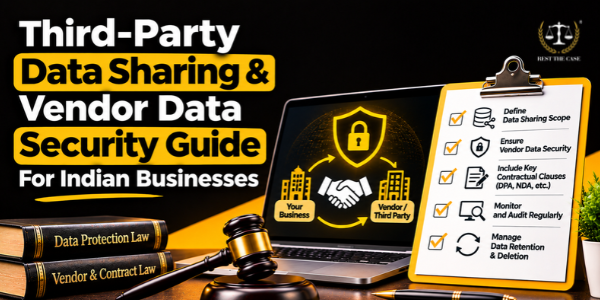
Third-Party Data Sharing & Vendor Data Security Guide For Indian Businesses

2.1. Different Types of Data Shared With Vendors
2.2. What Risks Come With Third-Party Data Sharing?
3. Which Laws Apply to Third-Party Data Sharing in India? 4. What Should a Vendor Data Processing Agreement Include? 5. How Can Businesses Check a Vendor's Security Before Signing a Contract? 6. How Should Businesses Control Vendor Access to Data? 7. Can Businesses Share Customer Data With Marketing Agencies, CRM Platforms, and AI Tools? 8. What Should Businesses Check When Vendors Store or Transfer Data Outside India? 9. Who Is Responsible If a Vendor Causes a Data Breach? 10. Third-Party Data Sharing and Vendor Security Checklist 11. Common Mistakes Businesses Should Avoid When Sharing Data 12. How Should Businesses Manage Vendor Security Throughout the Contract? 13. ConclusionModern businesses use cloud platforms to store information, CRM software to manage customers, payment gateways to process transactions, and marketing agencies to run campaigns. Sharing information with third parties creates certain risks.
This guide explains the main legal requirements in India and the practical steps businesses can take to protect their information when working with external vendors.
What Should a Business Check Before Sharing Data With a Third Party?
- Identify the data and purpose: Make a list of the information you plan to share. Clearly explain why the vendor needs it and identify the legal entity that will receive the data.
- Check the sensitivity of the information: Find out whether the data contains customer details, employee records, financial information, intellectual property, or confidential business plans.
- Review legal requirements: Confirm that sharing the information is consistent with your business purpose, privacy notices, customer commitments, and applicable laws.
- Examine vendor security: Review the vendor's access controls, encryption methods, data storage practices, and security procedures before allowing access to live systems.
- Obtain internal approval: Get written approval from the legal, IT, or management team. The approval should mention what information can be shared and the conditions the vendor must follow.
What Is Third-Party Data Sharing and Why Does It Matter?
Third-party data sharing means giving an external organisation access to business or personal information. Common examples of third-party service providers include:
- Cloud storage and hosting companies.
- Customer relationship management (CRM) platforms.
- Payroll and accounting service providers.
- Marketing and advertising agencies.
- Payment gateways.
- External auditors and consultants.
- Logistics and delivery partners.
Different Types of Data Shared With Vendors
- Personal Data: This includes information that can identify an individual directly or indirectly. Examples include customer names, phone numbers, email addresses, and employee salary details.
- Confidential Business Information: This includes internal financial reports, business strategies, source code, trade secrets, supply chain agreements, and other information that should not be shared publicly.
- Aggregated or Anonymised Data: This refers to information that has been combined or processed to remove personal identifiers, making it practically impossible to identify individuals again.
What Risks Come With Third-Party Data Sharing?
- Unauthorised access: A vendor employee may view or take business information without permission.
- Data breaches: Hackers or ransomware attacks may expose information stored in a vendor's systems.
- Misuse of information: A vendor may use customer records for its own marketing or product development without proper permission.
- Excessive access: A company may give a vendor access to an entire database when only a few records are required.
- Contract disputes: The business and vendor may disagree about data ownership, deletion, security responsibilities, or financial liability after a breach.
Which Laws Apply to Third-Party Data Sharing in India?
The main legal frameworks include the following.
- Digital Personal Data Protection Act, 2023
The Digital Personal Data Protection Act (DPDP Act), 2023, governs the processing of digital personal data in India. The Act uses two important terms:
- Data Fiduciary: The organisation that decides why and how personal data will be processed.
- Data Processor: The organisation that processes personal data on behalf of a Data Fiduciary.
For example, if a company hires an external payroll provider to process employee information, the company may act as the Data Fiduciary and the payroll provider as the Data Processor. The Data Fiduciary can engage a Data Processor under a valid contract. It must also ensure that the processor follows appropriate security measures and uses personal data only for the permitted purpose.
- DPDP Rules, 2025
The DPDP Rules, 2025, provide further details on implementing the DPDP Act. They cover administrative procedures, security safeguards, breach-related requirements, and implementation timelines. Businesses should review the applicable provisions and make sure their vendor contracts and internal processes meet the requirements that have come into force.
- Information Technology Act, 2000
The Information Technology Act, 2000, provides the legal framework for electronic transactions, cyber offences, and certain cybersecurity matters. Two provisions are particularly relevant to data protection:
- Section 43A: Deals with compensation for failure to protect sensitive personal data or information in the circumstances covered by the provision.
- Section 72A: Deals with punishment for intentional disclosure of information in breach of a lawful contract, where the required conditions are met.
- Information Technology (SPDI) Rules, 2011
The Sensitive Personal Data or Information (SPDI) Rules, 2011, deal with the handling of certain sensitive information, including passwords, financial details, and biometric information. The framework includes requirements relating to privacy policies, consent, and reasonable security practices.
- Sector-Specific Regulations
- Financial services: The Reserve Bank of India (RBI) has requirements relating to IT outsourcing, data security, data localisation, and vendor risk management for regulated entities such as banks and NBFCs.
- Capital markets: The Securities and Exchange Board of India (SEBI) has cybersecurity and technology-related requirements for regulated market participants.
- Insurance: The Insurance Regulatory and Development Authority of India (IRDAI) issues requirements relating to cybersecurity and risk management for insurers and other regulated entities.
Also Read: Importance Of Cyber Law
What Should a Vendor Data Processing Agreement Include?
- Purpose and Scope of Processing: The agreement should identify the data being shared and explain the exact service the vendor will provide. The vendor should not receive information that is unrelated to the work.
- Restrictions on Data Use: The vendor should not be allowed to sell, copy, analyse, or reuse the company's information for unrelated marketing, product development, or other purposes without proper authorisation.
- Confidentiality and Security Requirements: The agreement should require the vendor and its employees, contractors, and other authorised personnel to maintain confidentiality.
- Subcontracting Rules: The main vendor should be required to disclose relevant sub-processors and obtain the necessary notice or written approval before sharing the company's data with them.
- Data Breach Notification: The agreement should clearly state how quickly the vendor must inform the business about a suspected or confirmed security incident.
- Data Return and Deletion: When the contract ends, the vendor should return or securely delete the company's information, including applicable backup copies, according to the agreed terms.
- Audit Rights and Cooperation: The company should have the right to review the vendor's security practices. This include checking relevant audit reports, reviewing security certifications, or conducting agreed assessments.
How Can Businesses Check a Vendor's Security Before Signing a Contract?
- Review Security Policies and Procedures: Ask the vendor how it manages user access, software updates, employee training, data retention, and security incidents.
- Check Vulnerability Testing: Ask for recent summaries of external penetration tests and vulnerability assessments. These reports can help identify weaknesses in the vendor's systems.
- Review Security Certifications and Audit Reports: Depending on the service, ask for relevant certifications or independent audit reports, such as ISO/IEC 27001 certification and SOC 2 Type II reports.
- Understand Data Storage and Subcontracting: Ask where the vendor stores information and which employees or contractors can access it.
- Check the Vendor's Past Security Incidents: Review publicly available information about the vendor's security breaches, cyber incidents, and legal disputes over the previous three to five years.
How Should Businesses Control Vendor Access to Data?
- Share Only Necessary Information: Do not give vendors access to complete databases when they need only a limited set of records.
- Use Role-Based Access Control: Each vendor employee should have an individual account with suitable permissions. Multi-Factor Authentication should be enabled, especially for administrative access.
- Avoid Shared Passwords: Never share administrator accounts, master API keys, or root passwords with external teams. Individual accounts make it easier to identify who accessed a system and when.
- Keep Different Environments Separate: Production databases should remain separate from development, testing, and staging environments.
- Monitor Vendor Activity: Enable audit logs to record system access, file downloads, and important configuration changes. Review these records regularly to identify unusual activity or unauthorised data transfers.
Can Businesses Share Customer Data With Marketing Agencies, CRM Platforms, and AI Tools?
Yes, businesses can share customer information with external service providers when the relevant legal and contractual requirements are met.
Marketing Agencies and CRM Platforms
Companies often share customer leads, sales information, and support records with marketing agencies and CRM platforms. Before doing so, businesses should:
- Make sure their privacy notices explain the relevant use of third-party service providers.
- Check whether the platform tracks customers across other websites or uses their information to improve its own advertising systems.
- Sign suitable data processing and confidentiality agreements.
- Restrict agency employees from downloading customer lists onto unencrypted personal devices.
Generative AI Tools and External Language Models
Before sharing information with these tools, check:
- Model training: Does the provider use submitted information to train or improve its public AI models? Review available opt-out and data protection options.
- Data retention: Find out how long prompts, chat histories, server logs, and generated content are stored.
- Data minimisation: Remove unnecessary personal information, customer names, and sensitive financial details before submitting information to an external AI service.
Also Read: AI Compliance Guide For Businesses In India: Laws, Risks And Best Practices
What Should Businesses Check When Vendors Store or Transfer Data Outside India?
- Identify All Storage Locations: Ask the vendor for details of its main data centres, backup facilities, and disaster recovery locations.
- Review Contractual Security Requirements: The contract should require the vendor to maintain agreed security measures across all storage locations.
- Check Cross-Border and Localisation Rules: Review whether the business is subject to any sector-specific data localisation requirement.
- Review Customer and International Commitments: A company may also have obligations under customer contracts or foreign privacy laws, such as the European Union's General Data Protection Regulation (GDPR).
- Maintain Transfer Records: Keep a record explaining why information is transferred outside India, where it is stored, and what safeguards or legal arrangements apply.
Who Is Responsible If a Vendor Causes a Data Breach?
- Legal Responsibilities of the Business: The business may remain accountable for personal data under its control. It cannot assume that hiring a vendor transfers all its responsibilities to that vendor.
- Contractual Responsibility of the Vendor: The vendor's financial responsibility depends on the agreement between the parties. The business may be able to claim compensation or other remedies under breach notification clauses, etc.
- Vendor's Role During an Incident: The vendor should promptly inform the business about the incident as required by the agreement. It should preserve relevant logs, help isolate affected systems, and provide technical information needed for the investigation.
- Reporting Requirements: Depending on the incident and the applicable rules, reporting may be required to CERT-In, the Data Protection Board of India, sector regulators, or affected individuals.
Third-Party Data Sharing and Vendor Security Checklist
Compliance area | What the business should check |
|---|---|
Data inventory | Identify all information shared with the vendor and classify its sensitivity |
Business purpose | Confirm why the vendor needs the information |
Legal assessment | Review applicable DPDP requirements, sector rules, and consent arrangements |
Vendor due diligence | Examine security policies, testing reports, and relevant certifications |
Contract | Sign a DPA or suitable data protection clauses |
Access control | Apply least-privilege access, individual accounts, and MFA |
Subcontractors | Identify sub-processors and review their security obligations |
Data transfers | Check server locations, international transfers, and localisation rules |
Incident response | Agree on breach notification and cooperation requirements |
Data retention | Set rules for retention, return, and secure deletion |
Monitoring | Review access logs and reassess vendor security regularly |
Contract termination | Remove access and confirm data return or deletion |
Common Mistakes Businesses Should Avoid When Sharing Data
- Sharing too much database access: Giving a vendor access to the entire database when only a few fields are needed.
- Accepting standard contracts without review: Signing general vendor terms without adding suitable confidentiality and data protection clauses.
- Depending only on privacy policies: Assuming that a vendor's website privacy policy is the same as a binding agreement between the companies.
- Ignoring subcontractors: Allowing vendors to share information with other providers without proper approval or review.
- Not setting breach notification timelines: Failing to agree on how quickly the vendor must report a security incident.
- Overlooking data storage locations: Not checking where servers are located, which may create problems under sector-specific localisation rules.
- Leaving old accounts active: Forgetting to remove API keys, remote access, and database permissions after a project ends.
- Ignoring data deletion: Ending a contract without confirming that the vendor has returned or securely deleted the company's information.
How Should Businesses Manage Vendor Security Throughout the Contract?
- Maintain a vendor register: Keep a central list of active vendors, the information they can access, their contact details, and contract renewal dates.
- Classify vendors by risk: Identify high, medium, and low-risk vendors based on the sensitivity of the data they handle and the possible impact of a breach.
- Conduct regular assessments: Review high-risk vendors at least periodically, such as annually, and whenever they make major changes to their systems or services.
- Track security weaknesses: Record any gaps found during vendor assessments and follow up until the required corrective steps are completed.
- Review contracts before renewal: Recheck data protection clauses, security commitments, and subcontractor arrangements when renewing or changing a contract.
- Follow a proper exit process: When the relationship ends, remove all access and obtain confirmation that the company's data has been returned or deleted as agreed.
You Might Find These Helpful
Conclusion
Third-party data sharing is necessary for modern businesses, but it must be managed carefully. Companies should check vendors before onboarding them, sign clear data protection agreements, limit access, and monitor security throughout the contract. Strong controls and regular reviews can protect customer information, reduce legal risks, and build trust with business partners.
Disclaimer: This blog is for informational purposes only. If you require legal consultation, kindly contact an experienced Corporate Lawyer.
Frequently Asked Questions
Q1. Can a business share customer data with third-party vendors in India?
Yes. A business can share customer information when it has an appropriate legal basis, such as valid consent or another permitted ground under applicable law.
Q2. Is a Data Processing Agreement mandatory for every vendor?
The DPDP Act requires a Data Fiduciary to engage a Data Processor under a valid contract. A formal DPA or suitable binding data processing clauses are important when a vendor processes personal data on the company's behalf.
Q3. Who is responsible if a vendor leaks customer information?
The business may remain legally accountable to affected individuals and regulators for personal data under its control. It may also seek remedies from the vendor under the contract, depending on the indemnity, liability, and breach provisions.
Q4. Can vendors share customer data with their own subcontractors?
They should do so only as permitted by the agreement and applicable law. The main contract should require appropriate disclosure, notice, or approval before the vendor engages sub-processors.
Q5. Can Indian businesses store customer data outside India?
Cross-border transfers may generally be permitted under the DPDP framework, subject to restrictions that may be imposed by the Central Government and other applicable sector-specific requirements.

 Get Expert Advice and Solutions
Experienced lawyers for all legal matters wether it is for Family, Property, Criminal Cases, and More
Consult Now